Aeolus
Mariners' Museum, Uncurated Search Results
Type: Pungy
Year: 1871
Builder:
Location:

These records are found in the online catalog of The Mariners’ Museum and Park in Newport News, Virginia. Uncurated search results are presented to give researchers and interested readers an idea of whether the museum’s archives contain information about this vessel and whether it may be worthwhile to visit the museum’s catalog search page for further investigation. Uncurated results may be inaccurate or incomplete.
Search mode: Exact Name. Search phrase(s): "Aeolus". Results returned: 25. Results displayed in this table: 25.
Use these buttons to send uncurated search results to your own app or text document for further research. First, check the box for any row, or click "Select All" then uncheck any rows. Then click "Show Selections". You can then copy your selections from the text box and past them into your app.
| Fetch? | Row ID | Media | Date | Vessel | Place | Related Places | Inscription/Marks | Subject | Notes | Archive Number |
|---|---|---|---|---|---|---|---|---|---|---|
| 1 | 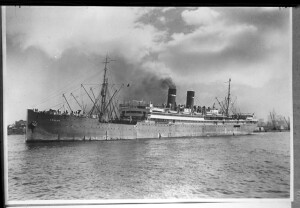 | 1919-1922 | Aeolus (Steamship : 1919). | Ships.; Bodies of water. | Copy negative of a photograph of the Aeolus. Broadside view of the ship in midstream. | MS0091/03.01-01#068 | ||||
| 2 | 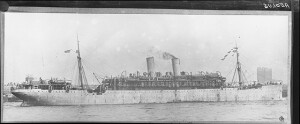 | 1883-1931 | Aeolus (Transport : I.D. 3005). | Aeolus, 1899-1937, UNK, Ex (Ger) Grosser Kurfurst, later City, at pier | Steamboats–United States.; Government vessels–United States. | This is a copy negative depicting the starboard side of an ocean liner converted to a military transport. | MS0091/03.02-01#0027 | |||
| 3 | 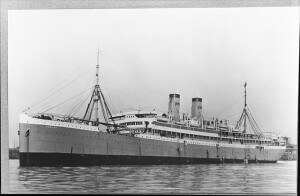 | 1883-1931 | Aeolus (Transport : I.D. 3005). | USS "Aeolus" (1899/1937), ex Ger. "Grosser Kurfurst", later "City of Los Angeles" | Steamboats–United States.; Government vessels–United States. | This is a copy negative depicting the port side view of the bow of a steamship moored in the water. | MS0091/03.02-01#0028 | |||
| 4 | 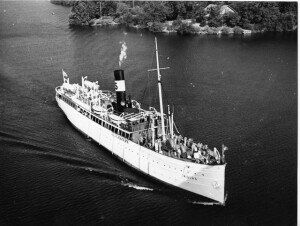 | WRITTEN ON VERSO: BUILT 1884, AT GOTHENBURG, BY MOTALA COMPANY. OWNED BY STOCKHOLM REDERIAKTIEL SVEN.RENAMED IBRA, BROKEN UP 1955-58 | Aerial view showing starboard side bow quarter of ship underway in river. Passengers seen on deck. Alternate Name: Ibra. | P0001.003/01-#PB25318 | ||||||
| 5 | 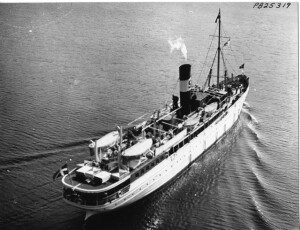 | WRITTEN ON VERSO: BUILT 1884, AT GOTHENBURG, BY MOTALA COMPANY. OWNED BY STOCKHOLM REDERIAKTIEL SVEN.RENAMED IBRA, BROKEN UP 1955-58 | Aerial view showing starboard side stern quarter of ship under way in river. Passengers seen on deck. | P0001.003/01-#PB25319 | ||||||
| 6 | No image URL. | Aeolus (Steamboat); Baltimore Dry Docks and Ship Building Company | Ships–Reconstruction–United States; World War, 1914-1918–Prizes, etc. | What we did to a German war prize : __being the story of the rejuvenation of the "Grosser Kurfurst," now the S.S. "Aeolus" __by the Baltimore Dry Docks & Ship Building Company | LB38167 | |||||
| 7 | 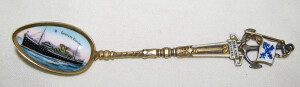 | SHORT DESCRIPTION: Obverse: In the bowl appears a port side view of a twin stack steamer in enameled colors. Also the inscription: D. GROSSER KURFURST. At the top of the handle appears the house flag of the North German Lloyd Line and the inscription: NRDD. LLOYD BREMEN. LABEL: GROSSER KURFURST Steel twin screw steamer built in 1899. Later the CITY OF LOS ANGELES. Souvenir spoons FS 186 FS 223 VESSEL INFORMATION- VESSEL NAME: GROSSER KURFURST ALL SHIPS NAMES: GROSSER KURFURST, AEOLUS, CITY OF LOS ANGELES VESSEL TYPE: STEEL TWIN STACK SCREW SCHOONER VESSEL BUILT: 1899 SHIP BUILDER: F. SCHICHAU SHIP OWNER: NORTH GERMAN LLOYD LINE VESSEL DIMENSIONS: 559'7" x 62' x 39' VESSEL HISTORY: Renamed AEOLUS, CITY OF LOS ANGELES. Under the latter name she was operated by the Los Angeles S.S. Co. Alternate vessel names: (1) GROSSER KURFURST (SCREW SCHOONER: 1899-1917); (2) USS AEOLUS (SCREW STEAMER, ID-3005: 1917-1919); (3) AEOLUS (SCREW STEAMSHIP: 1919-1922); (4) CITY OF LOS ANGELES (SCREW STEAMSHIP: 1922-1937). | CL1861 | |||||||
| 8 | No image URL. | AEOLUS (TANK VESSEL). | The author describes various solutions and proposals for the problem of oil pollution in particular and various responses to diasters. This article illustrates the Coast Guard's pollution program. The ATHOS spill, the AEOLUS incident and the TOWLE incident shows the Coast Guard's pollution program. | LB43954 | ||||||
| 9 |  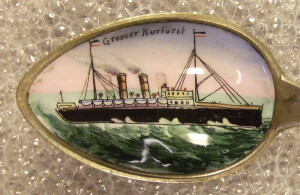 | SHORT DESCRIPTION: Obverse: In the bowl, in enameled colors, appears the starboard side view of a two stack steamer and the inscription: GROSSER KURFURST. LABEL: GROSSER KURFURST Steel twin screw steamer built in 1899. Later the CITY OF LOS ANGELES. Souvenir spoons FS 186 FS 223 VESSEL INFORMATION- VESSEL NAME: GROSSER KURFURST VESSEL TYPE: STEEL TWIN STACK SCREW SCHOONER VESSEL BUILT: 1899 SHIP BUILDER: F. SCHICHAU SHIP OWNER: NORTH GERMAN LLOYD LINE VESSEL DIMENSIONS: 560.6 x 62.3 x 35.9 VESSEL HISTORY: Renamed AEOLUS, CITY OF LOS ANGELES. Under the latter name she was operated by the Los Angeles S.S. Co. Alternate vessel names: (1) GROSSER KURFURST (SCREW SCHOONER: 1899-1917); (2) USS AEOLUS (SCREW STEAMER, ID-3005: 1917-1919); (3) AEOLUS (SCREW STEAMSHIP: 1919-1922); (4) CITY OF LOS ANGELES (SCREW STEAMSHIP: 1922-1937). | CL1802 | |||||||
| 10 | 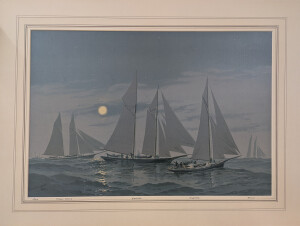 | SHORT DESCRIPTION: Chromolithograph, plate XIV, of Frederic Schiller Cozzens and J.D. Jerrold Kelley's 'American Yachts: Their Clubs and Races' published by Charles Scribner's Sons. Titled 'Moonlight on Nantucket Shoals ' showing yachts Ibis, Tidal Wave, Estelle, Sagitta and Aeolus. NOTES: LP 200- LP 225 are part of a set of lithographs in colors on wove paper by Frederic Schiller Cozzens (American, 1846-1928). Cozzens and Lt. J.D. Jerrold Kelley collaborated on the book 'American Yachts: Their Clubs and Races.' Between 1883 and 1884 Cozzens worked on watercolors of yachts and their marine settings which were turned into a folio suite of chromolithographs to accompany text written by Kelley. | CL18638 | |||||||
| 11 | No image URL. | United States. Coast Guard. | Oil pollution of rivers, harbors, etc. | The U. S. Coast Guard has an important role in the control of ocean pollution. The author describes various solutions and proposals forthe problem of oil pollution in particular and various responses to disasters. The ATHOS spill, the AEOLUS incident & the TOWLE incident illustrate the Coast Guard's pollution program. | LB60640 | |||||
| 12 | No image URL. | NOTES: Sketchbook No. 60 of pencil drawings created by Antonio Jacobsen from 1878 to 1918 for his artworks. VESSELS LISTED IN SKETCHBOOK NO. 60, DATED 1901 SABINE (Screw Steamship) BRECONSHIRE (Screw Steamship) (Vessel Built 1894-) J.L. LUCKENBACH (Screw Tug) (Vessel Built 1893-) POWDERHAM (Screw Steamship) (Vessel Built 1892-) NEPTUNO (Screw Steamship) (Vessel Built 1873-) AMERICAN (Bark) (Vessel Built 1895-) CASTANO (Screw Steamship) (Vessel Built 1900-) COULSDON (Screw Steamship) (Vessel Built 1901-) MAORI KING (Screw Steamship) (Vessel Built 1890-) AEOLUS (Screw Steamship) (Vessel Built 1894-) HEATHBURN (Screw Steamship) (Vessel Built 1901-) DUCHESSA DI GENOA (Screw Steamship) (Vessel Built 1884-) TOMOANA (Screw Steamship) (Vessel Built 1899-) KENT (Screw Steamship)(Vessel Built 1899-) CROYDON (Screw Steamship) (Vessel Built 1898-) CEREA (Screw Steamship) (Vessel Built 1900-) VALHALLA (Screw Steamship) (Vessel Built 1896-) LANGTON GRANGE (Screw Steamship) (Vessel Built 1896-) HADDON HALL (Screw Steamship) (Vessel Built 1898-) ST. MARY (Bark) (Vessel Built 1869-) NAVIGATOR (Screw Steamship) (Vessel Built 1900-) AMANA (Screw Steamship) (Vessel Built 1895-) ETONA (Screw Steamship) (Vessel Built 1890-) M.S. DOLLAR (Screw Steamship) (Vessel Built 1890-) M.E. LUCKENBACH (Screw Steamship) (Vessel Built 1898-) | CL28326 | |||||||
| 13 | 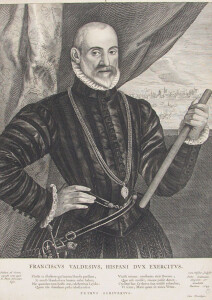 | NOTES: Translation of script below engraving: Louis Boisot, Admiral of the Fleet For citizens suffering from pestilence and panting breath, And now Saguntine bodies recked by starvation, The Commander grieves: indeed, what might that illustrious man not suffer, As compassionate love for the citizens aroused him. He then declared: O whorled Aeolus, since the earth is not permitted relief, Let the wave of Tethys demolish Spanish threats. Boisot conveyed into the city a great quanity of grain and other foods from the fields and sea, thereby, you have done greater harm to the enemy. Saguntine-refers to Sagunto, city in East Spain on the Mediterrenean Aelous- God of winds Tethys- a daughter of Uranus, wife of Oceanus and mother of Oceanides | CL15049 | |||||||
| 14 | 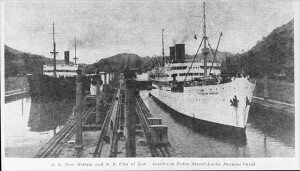 | 1883-1931 | City of Los Angeles (Steamship : 1922).; New Britain (Steamship : 1919). | Los Angeles S.S. Co. (later Matson Navigation Co), Photostat negative, (3) "City of Los Angeles" 1899 (1) ex Ger "Grosser Kurfurst" (2) later U.S.S. "Aeolus" | Steamboats–United States. | This is a photostat of a clipping depicting the bows of two steamship. | MS0091/03.02-01#0623 | |||
| 15 | No image URL. | Constitution (Frigate : 1797).; United States. Navy–History–18th century.; United States. Navy–History–19th century.; United States. Navy–History–20th century.; Guerriere (Frigate : 1806).; Java (Frigate : 1811).; Babbitt (Destroyer : DD-128).; Upshur (Destroyer : DD-144).; President (Frigate : 1800).; Constitution (Frigate : 1797)–Bibliography.; Constellation (Frigate : 1797).; Missouri (Battleship : BB-63).; Midway (Attack aircraft carrier : CVA-41).; Kearsarge (Screw sloop : 1862).; Constitution (Frigate : 1803).; Constitution (Frigate : 1809).; Constitution (Frigate : 1860).; Constitution (Frigate : 1931).; Constitution (Frigate : 1821).; Constitution (Frigate : 1852).; Constitution (Frigate : 1877).; Emulous (Sloop : 1813).; Africa (Ship-of-the-Line : 1805).; Cyane (Post ship : 1806).; Levant (Post ship : 1813).; Pictou (Sloop : 1813).; Belvidera (Frigate : 1809).; Shannon (Frigate : 1806).; Tenedos (Frigate : 1812).; Philadelphia (Frigate : 1800).; L'Insurgente (Frigate : 1793).; Nautilus (Brig : 1811).; Herndon (Destroyer : CG-17).; Enterprise (Schooner : 1799).; Intrepid (Ketch : 1803).; Junon (Frigate : 1810).; Aeolus (Frigate : 1801). | United States–History–Tripolitan War, 1801-1805.; United States–History, Naval–19th century. | Frigates–Design and construction. United States | Constitution (Frigate : 1797). | LB108805 | ||||
| 16 | 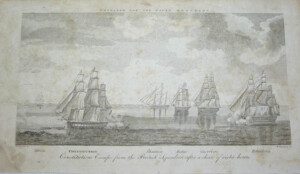 | SHORT DESCRIPTION: Wood engraving depicting "Constitution's escape from the British Squadron after a chase of sixty hours." Artist Michele Corne. Engraved by William Hoogland and published in "The Naval Monument containing official and other accounts of all battles fought between the Navies of the United States and Britain during the late war...", Boston, by George Clark, some time between 1830 and 1840. VESSEL INFORMATION-- VESSEL NAME: CONSTITUTION VESSEL TYPE: Frigate, 44 gun SERVICE DATES: 1797- SHIP BUILDER: Hartt Shipyard BUILDER LOCATION: Massachusetts, Boston VESSEL DESIGNER: Joshua Humphries ASSOCIATED PLACE: Massachusetts, Boston VESSEL HISTORY: Built during the years 1794-1797, and was launched October 21, 1797. Cleared for sea on first voyage on July 22, 1798. Ship was rebuilt in 1927-1933 under the direction of Commander John Abel Lord USN . Restorations made 1833-1835, 1855-1860, 1871-1876, 1906, 1927-1931, 1973-1974. MAJOR EVENT: Barbary Wars; War of 1812 CAPTAINS OR OTHER RELATED PEOPLE: Joshua Humphries (designer SHIP OWNERS: US Navy VESSEL DIMENSIONS: 175' (O.A.); 45' (breadth); 20' (depth) | CL17338 | |||||||
| 17 | 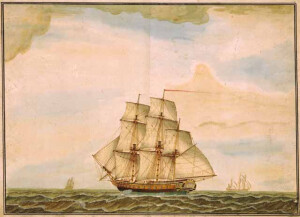 | NOTES: The entry from the auction catalog for the original watercolor sold from the V. Winthrop Newman Collection on February 7, 1921 reads: A clever representation of a frigate in full-sail, carefully detailed and drawn with great precision. In the distance are seen two other vessels; the shortness of the mizzen-mast is remarkable, no provision being made for the to'gallant sail. The artwork was purchased by Pauline Riggs in this sale. Newman, of London and New York, was a member of the British Society for Nautical Research. His collection was sold at an unrestricted public sale at the American Art Galleries in New York on February 7, 1921. It's unclear when Mrs. Riggs aquired the aquatint (LP 2897) that appears to be related to this watercolor. NOTES: HMS Southampton had a very long life built in 1757 and wrecked in 1812. The ship was active during the American Revolutionary War. --The 'Table of the English Navy including the Cruising Stations of Commissioned Ships and the Condition of Non-Commissioned Ships' under date of 21 June 1776 lists Southampton under the category of 'Ships requiring a few months repair.' --On December 25, 1776, the Admiralty ordered Captain William Garnier and HMS Southampton, then at Plymouth, to proceed to Cape Ortegal and cruise north of it, between latitude 45 and 47, for the protection of the trade of His Majesty's Subjects, and "to use your best endeavours to intercept, seize and destroy any cruisers or other vessels belonging to the rebellious colonies of North America which you may be able to come up with." She was to continue on that station until February 6, 1777 and then return to Cork. --February 14, 1777 Southampton and the sloop Cygnet were ordered to escort a convoy to the West Indies. The convoy safely arrived in Jamaica on June 14th, albeit with a sprung mast. Vadm. Clark Gayton reported in July that Southampton was on a cruise with the Winchelsea, Glasgow, Race Horse and Porcupine. On July 4th Southampton fell in with two Spanish 74-gun ships between Heneaga & Cape Nichola full of troops and bound for Havanna. On July 6th Southampton fell in with another 74-gun ship also bound for Havanna. The journal of Capt. William Garnier shows the ship was still stationed at Jamaica in October 3rd. In the journal entry he reported that the boat's tender, named Snail, arrived with a schooner named Tryall from Salem loaded with fish and lumber. --November 17, 1777, Gayton reported Southampton on a cruise with Lowestoffe. Garnier's journal reports on the 11th the Southampton's tender arrived with the ship was sailing off Port Royal with the Washington snow, loaded with rice. --December 7, 1777, Captain Garnier reported that while cruising off Point Isabella on the north side of Hispaniola Southampton chased several small American vessels. When a French frigate arrived and intervened the small American vessels escaped. --On December 19th Garnier's journal indicates the Southamptons boats took the Lark brig with fish & lumber from Newberry for the Cape. Manned the prize and sent it to Jamaica. It was actually the brig Lark from Baltimore, laden with shingles. --On December 21st Garnier's journal notes the capture of the sloop Susannah, Parsons with fish and lumber from Cape Anne. Manned and sent to Jamaica. On December 22nd, Garnier's journal notes the capture of the ship Speculation, Pike master, from Newburyport loaded with lumber. Took the prize in tow and headed for Jamaica. --In a table titled "A List of All Captures which have been condemned in the Vice Admiralty Court of Dominica, since the breaking out of the rebellion in North America' Southampton is listed as having recaptured the snow Prince George. --The Journal of HMS Aeolus, Capt. Christopher Atkins, reported Southampton arrived at Port Royal, Jamaica on December 27 with two prizes. --January 17, 1778 the Snail tender (sloop of war) brought in the prize schooner Unity, Hilton, from Salem with fish and lumber. --The table “A List of Rebel Vessels, Taken by the Squadron, of His Majesty’s Ships & Vessels, Under my Command at Jamaica, between the 21st day of December 1775 and the 26th day of February, 1778” published in volume 11 of ‘Naval Documents of the American Revolution’ lists all of the prizes taken by Southampton or one of its tenders. Other prizes from volumes 12 and 13 are also included in this list: 1) sloop Swift, loaded with sugar; 2) schooner Sally from Boston loaded with fish and lumber; 3) unnamed schooner from Carolina loaded with staves and tobacco; 4) schooner Hope loaded with tobacco, staves &c.; 5) schooner Georgia Packet, loaded with rice and indigo; 6) schooner Tryall from Salem loaded with fish & lumber; 7) schooner Sally from Georgia loaded with rice and coffee (captured before October 18, 1777); 8) snow Washington loaded with rice ( Captured before November 11, 1777); 9) schooner Hazard, John Smith, from Virginia loaded with tobacco and flour (Captured on 7 Dec. 1777, from Virginia to Cape François); 10) sloop Speedwell, Thrift, from South Carolina loaded with lumber and rice; 11) brig Lark, from Baltimore loaded with shingles &c (Captured on 19 Dec. 1777, from Newburyport to Cape François); 12) ship Speculation, Pike, from Newport with Lumber (Captured on 22 Dec. 1777, from Newburyport to Saint-Domingue); 13) schooner Unity, Hilton, from Salem loaded with fish & lumber (Captured on January 17, 1778); 14) brig Henry, Dailey, from North Carolina loaded with lumber &c.; 15) Southampton’s tender Vixen participated in the capture of the schooner Angelina from South Carolina to Cape Francois with a cargo of tobacco, rice and indigo; 16) one of the tender’s of Southampton participated in the capture of the sloop Swallow in Isabella Bay, Kahue master, 20 tons burthen with a cargo of tobacco; 17) schooner Barter, Jno. Parsons, 70 tons, from Newburyport to Cape Francois with a cargo of fish and lumber, taken at Heneaga on March 28, 1778; 18) participated with Niger in capture of sloop John’s Milsey, loaded with tobacco staves and corn; --On March 7, 1778 Southampton was in Pensacola working on the defense of West Florida (Louisiana) against American rebels. -- June 25,1778 Southampton helped escort a convoy of 104 ships from Blue Fields Bay, Jamaica. War of 1812 The United States brig Vixen was captured by HMS Southampton on November 22, 1812 during the War of 1812. Five days later both vessels were wrecked on a reef in the Bahamas, marooning everyone on Conception Island for about ten days. After rescue and transport to Port Royal, Jamaica Vixen’s crew were imprisoned on the Loyalist prison ship. See the attached publication: 'A Narrative of the Capture of the United States Brig Vixen, of 14 guns, by the British frigate Southampton; and the Subsequent loss of both vessels, on a reef of rocks, off Conception Island...' by one of the Vixen's crew, for a detailed account of the capture and shipwreck. | CL6612 | |||||||
| 18 | 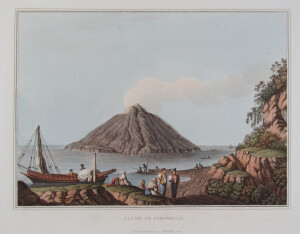 | SHORT DESCRIPTION: Hand-colored aquatint view titled "Island of Stromboli" published in 'Views in the Ottoman Dominions, in Europe in Asia, and some of the Mediterranean Islands. From The Original Drawings Taken For Sir Robert Ainslie, By Luigi Mayer with Descriptions Historical and Illustrative.' London: Printed by Thomas Bensley, Bolt Court, Fleet Street for Robert Bowyer 80, Pall Mall, 1810. The image shows a view of the island of Stromboli from the island of Basiluzzo. Smoke issues from the top of Mount Stromboli. In the forefround a large trading or fishing vessel is against the shoreline at the left. It has a forward raking mast held up by lines and blocks and a small arched canvas cover at the stern. In the foreground at the center sit three women and two men who are standing. Behind them are two men or boys fishing on the shoreline with poles while other lounge on the beach. On the right side of the image are rocks and vegetation. NOTES: Text from 'Views in the Ottoman Dominions, in Europe in Asia..." that accompanies the plate 'Island of Stromboli, one of the Lipari Islands': Stromboli is the last of the Lipari islands to the north-east. At a distance it appears to form one large cone, but on a nearer view the mountain is perceived to terminate in two summits of different heights. It is steep and inaccessible for three fourths of it's circumference, but on the north-east the bast stretches out, and forms a sloping plain, terminating in a beach on the seashore. This slope, which extends two thirds of the way up the mountain, is inhabited, and produces excellent fruits. It has a few plantations of cotton, and some vineyards, on the produce of which about two hundred persons are maintained. It is a singular circumstance, that on the south-east, about half way up the volcano, a spring of cold fresh water, light, and excellent for drinking, issues out from amid the loose cinders, lava and scoriae. This spring never dries, and is now a valuable resource for the inhabitants, when their cisterns of rain-water are empty. Mr. Dolomieu, who discovered the spring, imagines that it proceeds from the sea water raised in vapour by the subterranean fire, and condensed in the loose soil of the summit; the process of distillation being thus performed by nature on an extensive scale. In this island the ancients placed the palace of Eolus, the god of the winds. The annexed view was taken from the island of Basiluzzo, on the south-west. | CL18380 | |||||||
| 19 | No image URL. | SHORT DESCRIPTION: Wooden cane with silver handle reputedly made from wood salvaged from the wreck of the American Revolutionary War privateer George. NOTES: [J. Willoz-Egnor, May 16, 2025] The history behind this cane cannot be positively ascertained. It was reported in American, British and Canadian newspapers in 1888 and 1889 that in, or prior to, August 1888 the dry dock contractors J. E. Simpson & Co. of Brooklyn had found and later recovered the frame and keel of the American privateer George while dredging in St. John’s harbor in Newfoundland (the first report was made in New York on August 25, 1888). The many newspaper articles found tend to show a confusion of the facts, but a very thorough report was published in ‘The Brooklyn Eagle’ on September 29, 1888, shortly after the discovery of the wreck. The article reported that the Simpson company was building a new dock for the Newfoundland government in St. John’s harbor. During dredging operations, the frame and keel of a sunken vessel were uncovered and removed, and an investigation was undertaken to determine the age and origin of the wreck. A resident of St. John’s, Mr. Thomas Withycomb, found a report in his grandfather’s journal that seems to provide the wreck’s history. Withycomb’s grandfather was John Dambrell, who served as port captain in St. John’s in the last part of the 18th century. The journal entry reads “On July 15, 1781, the report was brought into St. John’s that two American privateers were taking the fishermen out of their boats at Cape Spear and sinking the boats. His majesty’s ship Pluto was lying in St. Johns at the time, getting her rigging repaired, which the captains of the privateers knew. At 6 AM the news was brought in and his Majesty’s ship Pluto began to get ready for sea. So short was the time she took to get ready that she sailed at 9 o’clock AM, and at 12 o’clock the same day she came in with the two privateers in tow, one called the Avenger and the other George. Both of these vessels, by order of Vice Admiral John Campbell, who was governor at that time, were dismantled: the George was cut down alongside of Captain Dambrell’s wharf.” Research on Ancestry.com does show that a John Dambrell was born about 1760 (another family tree reports born in 1757) in St. John’s, Newfoundland. He died in St. John’s in 1819. His daughter, Jane Dambrell, was born in 1793 (died 1852, headstone spells name Dambrill) and she had a son named Thomas Peter Withycomb(e) (1832-1894). With the people well established, the source of the information seems credible. However, there are several discrepancies in the journal entry. First, Vice Admiral John Campbell was not appointed governor of Newfoundland until April 1782. This mistake might indicate that Dambrell did not write the journal entry at the time of the event and misremembered who was governor at that time. It is also possible that Dambrell got the date of the event wrong and the capture occurred in 1782. The second, bigger problem, is that no Royal Navy ship named Pluto served in Newfoundland during the American Revolution. All of the Royal Navy ship’s named Pluto were 8-gun fireships (#1 purchased 1745 sold 1747; #2 purchased 1756 sold 1762; #3 built as Tamar in 1758, renamed Pluto in 1777, captured in 1780; #4 built 1782 sold 1817] and none ever served on the Newfoundland Station. Newspaper reports indicate the ships on the Newfoundland Station in 1781 are the: HMS Portland (50, Luttrell), Danae (32, Lloyd), Maidstone (28, Parker), Vestal (28, Berkeley), Surprize (28, Reeves), and Fairy (16, Yeo). Other vessels that might have been transiently on the Newfoundland Station are the HMS Morning Star (formerly the American privateer Congress captured by the HMS Oiseau in 1781), HMS Danae, HMS Cygnet, HMS Oiseau, HMS Aeolus and HMS Ulysses. It’s possible that Dambrell confused the name of the vessel and it was HMS Portland that made the captures, but until further information comes to light the name of the capturing vessel should remain anonymous. The third problem is that while a search of existing Continental and State records shows many privateers named George [Massachusetts Privateers of the Revolution lists four vessels; Rhode Island State Digital Archives shows two vessels; Privateers Commissioned in Philadelphia shows six vessels], no reports of its capture near Newfoundland nor it’s sinking in St. John’s harbor have been found. No reports of a privateer named Avenger appear in the published resources. This does not mean the event did not occur. It is a well-known fact that a full and complete listing of American privateers operating during the Revolutionary War cannot be compiled as Continental and State records are duplicative and incomplete. According to Eric Dolan, the best source of basic facts on privateering can be found in the Library of Congress’s ‘Naval Records of the American Revolution.’ While this source does list several privateers named George, their careers nor how they met their end are included in the publication. It is also a distinct possibility that the two vessels were never registered as privateers. Frederick Rowe states in ‘A History of Newfoundland and Labrador’ that forty American privateers were taken between 1780 to 1782 but that they represent only a portion of the total American losses. Gardner Weld Allen’s book ‘Massachusetts Privateers of the Revolution’ shows that some American privateers were taken and carried into St. John’s, but these vessels don’t appear in searches on Newspapers.com or in the British Newspaper Archive. Additionally, some newspaper reports aren’t specific about the names of the privateers captured (see for example the report in the Oxford Journal dated January 5, 1782, which reports that in a six-week period Royal Navy ships had captured twenty-six sail of American privateers and sent them into St. John’s. The same report in another newspaper says the number is 16. NOTES: Excerpt from letter of W.H. Tripp, 10/10/1947: "Secretary Tracy, Acting Rear-Admiral Walker, Commodore White, Chief of the Bureau of Yards and docks, and two or three other officials of the Navy Department, received yesterday canes made of oak taken from the timbers of the privateer GEORGE, sunk in the harbor of St. Johns, Newfoundland, in 1781, by the British frigate PLUTO. A year or two ago Simpson & Co., dock builders, were dredging for the foundation of a new dock, and brought up the remnants of the old ship out of which the canes were made. They are adorned with handsome oxidized silver handles.” Newspaper reports from 1888 and 1889 list canes being given to a number of US officials: [some corroborate Tripp’s 1947 letter] Secretary Tracy, Acting Rear Admiral Walker, President Cleveland, Congressman Cummings, Naval Constructor Hichborn, Secretary Whitney, Commodore Harmony, Private Secretary Fletcher and Congressman Felix Campbell. NOTES: Newspaper article from 'The Daily Colonist', September 24, 1888, page 4: The President's New Cane. The recent discovery in the harbor of St. John's, Newfoundland, during dredging operations, which were being carried on for the purpose of building a government dock, of the hull of an old American privateer sunk in 1781 is an interesting incident. There seems to be no doubt that the hull is that of the privateer George, which was thought to have been scuttled and sunk by her crew after being captured by the British man-of-war Pluto. The keel of the old vessel was built of the best seasoned oak, and has apparently not suffered from the effects of its immersion for 106 or 107 years. Pieces of it have been chipped off and made into walking sticks. The wood is so hard as to admit of a high polish, and makes a very handsome cane. One of these sticks has been sent to President Cleveland. (New York Times) NOTES: Article from The Times Leader, September 10, 1888, page 2: A Relic of Patriotism. While dredging in the harbor of St. Johns, Newfoundland, preparatory to building a dock for the Colonial government, the frame and keel of a sunken vessel was found. It was the wreck of the American privateer George, sunk by the British man of war Pluto in July 1781. The George and another privateer had captured a British ship outside the harbor, and were captured in turn by the Pluto. The George was afterward sunk in the harbor. It is said she was scuttled by some of her crew to prevent her being of service to the British government. Her keel is of English oak. When found by Mr. Simpson it was in magnificent condition. There was not the least sign of decay, although it had lain in the water over 106 years. The firm turned it into walking sticks. It took a polish like a mirror. Several of these sticks were sent to Congressman Cummings and other members of the house recently. They have silver handles and are handsome canes as ever were turned out. One of the canes was also sent to President Cleveland, who values it very highly. (New York Evening Sun) | CL2838 | |||||||
| 20 | 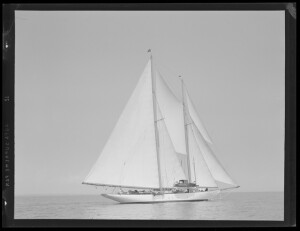 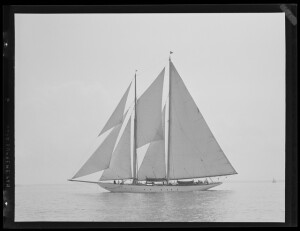 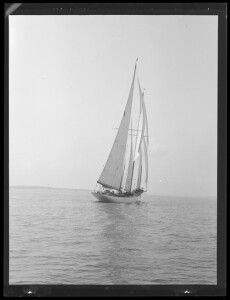 | 1939-1940 | Yachts–Photographs.; Yachting–Photographs.; Sailboats–Photographs.; Motorboats–Photographs.; Cutters–Photographs.; Ketches–Photographs.; Schooners–Photographs.; Sloops–Photographs.; Yawls–Photographs.; Lighthouses–Photographs. | Contains photographic negatives of the auxiliary schooner Aeolus, the power yacht Quelque Chose", unidentified pwoer and sailing yachts, the auxiliary yawl Condor, the auxiliary yawl Escapade, the auxiliary ketch Gitana, the auxiliary yawl Hurricane, the auxiliary schooner Indra, the auxiliary ketch Lazy Lass, the auxiliary yawl Lone Gull II, the schooner Mistress, unidentified lighthouse, the auxiliary cutter Orient, the auxiliary sloop Evangeline II, the sloop Truant, the auxiliary sloop Tyee, the auxiliary cutter Valkyrie, and the auxiliary ketch Valkyrie. | P0002.001/50-139 | |||||
| 21 | 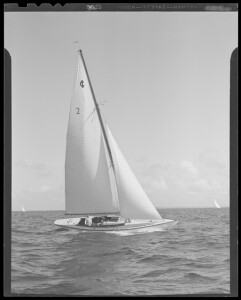 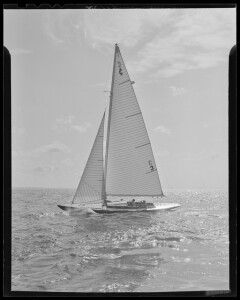 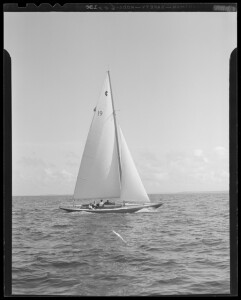 | 1939-1940 | New York Yacht Club–Photographs.; Seawanhaka Corinthian Yacht Club (Oyster Bay, N.Y.)–Photographs.; International Star Class Yacht Racing Association–Photographs.; Boston (Turbo Steamship : 1924)–Photographs. | New York (N.Y.)–Photographs.; Newport (R.I.)–Photographs.; Oyster Bay (N.Y. : Bay)–Photographs. | Yachts–Photographs.; Yachting–Photographs.; Yacht clubs–Photographs.; Yacht racing–Photographs.; Sailboats–Photographs.; Motorboats–Photographs.; Cutters–Photographs.; Schooners–Photographs.; Sloops–Photographs.; Passenger ships–Photographs.; Cruise ships–Photographs.; Yawls–Photographs. | Contains photographic negatives of the New York Yacht Club and the New York Yacht Club cruise, unidentified International class vessels, the International class vessel Susan, the International class vessel Maid of Honour, the Seawanhaka class vessel Heather, the Seawanhaka class vessel Mist, the Seawanhaka class vessel Swift, the Seawanhaka class vessel Wildo, shots of a wind-driven light plant, the auxiliary yawl Manxman, the auxiliary sloop Arturus, the auxiliary yawl Blue Sea, unidentified auxiliary cutters, the auxiliary schooner Draconis, the sloop Halvis, the auxiliary schooner Jesting II, the sloop Typhoon, the power yacht Elco, the power yacht Jama, the power yacht Judity R, the power yacht Jug, the power yacht Whirligy, the Handicap class vessel Rose, the Handicap class vessel Coquette, the auxiliary cutter Mistral, the International class vessel Allegra, the International class vessel Feather, the International class vessel Aileen, unidentiified Atlantic Coast class vessels, unidentified Victory class vessels, the International Star class vessel Andiamo V, the International Star class vessel Spirit, unidentified International Star class vessels, the International Star Class vessel Spitfire, the passenger ship Boston, and the auxiliary schooner Aeolus. | P0002.001/50-138 | |||
| 22 | 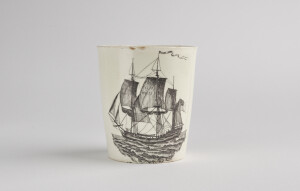 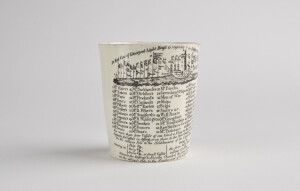 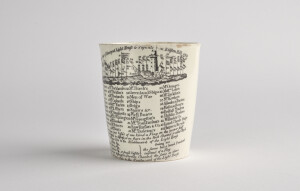 | SHORT DESCRIPTION: Creamware beaker without handle. The beaker is 3-7/16” height and 3-1/8” diameter at the top and 2-⅜” diameter at the base. The beaker is in good condition with some random staining and minor chips near the rim. The beaker is decorated with black transfer-printed images. On one side is a black transfer-printed image showing a port broadside view of a full-rigged British merchant ship under sail. The sails set include a flying jib and jib on the bowsprit. On the foremast a fore topsail (the foresail is furled). There is a fore topgallant sail mast and yard, but no sail appears. Between the foremast and mainmast a quadrilateral main topmast staysail is set. On the mainmast the mainsail is furled, the main topsail is set. The mast and yard of the main topgallant sail are visible but there is no sail. On the mizzenmast the mizzen topsail and mizzen sail are set. A long pennant with a cross of St. George at the hoist and forked fly end is flying from the mainmast. Interestingly the pennant is flying towards the stern rather than the bow. A British flag flies at the stern, again, it is pictured flying in the wrong direction. The sea underneath the ship is wrapped in a rococo design. On the opposite side is a black transfer-printed view of the signal tower and flagpoles at Bidston Hill (the windmill is not included), including flags numbered from 1 to 44 sitting to the north and south of the lighthouse. The transfer-print is titled “An East View of Liverpool Light House & Signals on Bidston Hill 1788.” Beneath the image is a numbered list of the shipowners keyed to the flags and a set of instructions for reading the signals. Reading from left to right, the names, in four columns, are: 1. Mr. Slater's; 2. Mr. Baker's; 3. Mr. Watt's; 4. Mr. Kent's; 5. Mr. Fisher's; 6. Mr. Galley’s; 7. Mr. Bolton's; 8. Mr. Ingram's; 9. Mr. Ashton's; 10. Mr. Kenyon's; 11. Mr. Bent's; 12. Mr. Backhouse's; 13. Mr. Dickson's; 14. Mr. Freeland's; 15. Mr. Copland's; 16. Messrs. Earle's; 17. Mr. R. Fisher's; 18. Mr. Staniforth's; 19. Mr. R. Wilding's; 20. Mr. Brooks's; 21. Mr. France's; 22. Mr. Boats's; 23. Mr. Birch's; 24. Greenland Ships; 25. Men of War; 26. Ships; 27. Brigs; 28. Snows &c; 29. Well Boats; 30. Mr. Gregson's; 31. Mr. Tomlinson's; 32. Rawlinson & Co.; 33. Mr. Tarleton's; 34. Mr. Orange’s; 35. Messrs. Lakes's; 36. Mr. Jackson's; 37. Mr. Kewley's; 38. Allanson & Barton; 39. Mason & Bourn; 40. Belfast Traders; 41. Dublin Traders; 42. Willock & Co.; 43. London Cheese Ships; and 44. Harper & Brade. Underneath the columns are the instructions for reading the signals: For more than four Vessels of one kind a Flag on the proper staff., Signals for Vessels in distress, or on shore in the Rock Channel or about Hoyle, On the Oblique Pole to the Southward of the Light House, Coming in, Ship [symbol of a ball with a flag half Mast], Brig [a symbol of a cone, broad end up, and flag at half mast], Snow or small Vessels [symbol of a cone with point up and a flag at half mast], Going out, The same [as ship] but a broad Pendant instead of a Flag, signals for Distress in Formby Channel the same as above on the Oblique Pole to the Northward of the Light House. The beaker is unmarked leaving the manufacturer(s) identified. In Transactions of the Historic Society of Lancashire and Cheshire, session 1880-1881, volume XXXIII, Charles T. Gattey discusses local manufacturers in the article “The Liverpool Potteries.” Gatty indicates the firm of John Sadler and Guy Green on Harrington Street were early producers of printing on pottery. Unfortunately, Sadler retired in 1770 which predates the estimated date of this beaker (1788). Gatty does indicate that “much of the ware upon which their [Sadler and Green] prints appear were made by Josiah Wedgwood. According to printedbritishpotteryandporcelain.com, “From about 1761 Wedgwood was sending creamware to Liverpool to be printed at the Sadler workshop. This grew into a large business and continued into the period when [Guy] Green was running the printing business alone.” As there weren’t too many firms actively printing on pottery in Liverpool at the time, it’s possible this jug was one of those printed and decorated by Green (who didn’t retire until 1799) for the Liverpool market. If, as printedbritishpotteryandporcelain.com states, the business between Wedgwood and Green was large, it’s possible that Green bought creamware from Wedgwood for the printing of the Bidston Hill images. Of course, this is merely conjecture at this point. NOTES: According to bidstonhill.org.uk in 1763 a signal station was built on Bidston Hill and functioned as a complicated early warning system using flags and flagpoles. Bidston Hill can be seen for many miles in all directions and the windmill there served as a navigational daymark long before the erection of the signal station. In 1778 there were 14 flagpoles and by 1820 there were 195 poles. Each flagpole was 30 ft (9.14 m) tall and made of Baltic Pine. As merchant ships rounded the Point of Ayr or sailed past Formby Point the ship would be spotted and identified. Flag runners were employed to watch for ships and had 11 minutes to raise the correct company’s flag on the right pole, followed by the correct cargo flag. This enabled supervisors in the docks to ready their workforce to unload the ship (and it meant the workers would be paid only for the time they spent working). The flag signaling station operated until about 1840. A lighthouse was built at the station in 1771 by Liverpool's dockmaster William Hutchinson as a navigational aid. The lighthouse was designed to work in conjunction with the Leasowe Lighthouse to form a pair of leading lights that helped ships avoid sandbanks in the channel to Liverpool. In his 1795 history of Liverpool, James Wallace wrote: “There are at this time fifty-eight [signals], of which forty-nine belong to particular merchants, the remainder are to distinguish and shew if the vessels coming in are Greenlanders, men of war, or if the vessel is ship, brig, or snow; there are also immediate signals to the town of all vessels seen in distress in either of the channels, that thereby speedy assistance may be given.” NOTES: According to printedbritishpotteryandporcelain.com, the earliest version of the Bidston Hill image is dated 1788 and has 43 numbered flags. A second version with 47 numbered flags was also produced in 1789. On the 1789 image, Mr. Galley's name appears but Mr. Orange's does not indicated the image was produced sometime between January (Orange's death) and April 1789 (Galley's death). In 1793 a third version with 56 numbered flags was produced and after France declared war on Britain a fourth version with a new flag indicating “Enemies” was added. With the date 1788 and a list of 44 names, this beaker seems to be one of the earliest examples of the Bidston Hill decorated creamware. NOTES: The flags in the image represent a mix of Liverpool merchants, many of which are engaged in the slave trade. Research has been unable to provide the exact identities of some of the men/companies. 1) Gill Slater was a Liverpool merchant who made 48 slave trading voyages between 1759 and 1793. Slater was part owner of the ships: Richmond, Hannah, Prince Tom, Betty, York, Lancashire Witch, Ingram, Kitty, Will, Sportsman, President, Defiance, Tartar, Wasp, Edward, Saint Leger, King George, Anna, Chesterfield, Comet, Mary (wholly owned), Seaflower, Commerce, Isabella and Tammerlane. He appears to have conducted other business as he was part owner of a fishing smack named Liver. Slater also conducted privateering voyages during the American Revolution. In 1777 Slater was part of a committee formed to draw up a plan for the better regulation of the slave trade. 2) Peter Baker (1731-1796) was a Liverpool merchant and slave trader in partnership with his son-in-law, John Dawson. According to the Slaving Voyages database, between 1768 and 1789 Baker was part owner of ships on 54 slaving voyages. He and Dawson started slaving voyages together in 1781 (both were active before that point, just not together). According to Stephen Behrendt in “The Captains in the British Slave Trade from 1785 to 1807” between 1783 and 1792 Baker and Dawson was the largest company of slave traders in England and had a contract with the Spanish government to supply enslaved peoples to the Spanish colonies between 1785 and 1788. Behrendt states that even after the Spanish market opened to all merchants in 1788, Baker and Dawson remained the leading British slave trader to the Spanish Caribbean. Captain William Sherwood was given command of Baker & Dawson's Princess Royal (596) from 1786 to 1788, Brothers (325) in 1789, Garland (525) in 1790 and 1791, and Elliot (271) in 1792. Between 1785 and 1795 Joseph Fayrer sailed four voyages for Baker & Dawson, William Forbes and Joseph Withers each sailed five, and Thomas Molyneux commanded six. Ships partially or wholly owned by Baker and Dawson included: Mosley Hill, Princess Royal, Hero, Champion, Telemachus, Prince, Elliott, Garland Sisters, Young Hero, Brothers, Blaydes, Carnatic, and Mentor. According to William Gomer in History of the Liverpool Privateers and Letters of Marque: With an Account of the Liverpool Slave Trade Baker and Dawson had a shipbuilding firm on the Estuary Bank. 3) Richard Watt (1724-1796), a Liverpool merchant. According to History of the Liverpool Privateers and Letters of Marque: Richard Watt came to Liverpool from Standish, near Wigan, around 1740 and was hired by Mr. Geoffry Walley to look after his horse and chaise. Watt was sent to evening school and Walley advanced him to the counting house and employed Watt as a supercargo to Jamaica. Watt settled in Jamaica and made a large fortune. Watt returned to Liverpool in August 1782 as head of the firm Messrs. Watt and Walker. Watt died in 1796 leaving a fortune of around half-a-million pounds to his two nephews, Richard Watt and Richard Walker. 4) Richard Kent, Liverpool merchant. The Voice of Liverpool Business: The first chamber of commerce and the Atlantic economy, 1774-c.1796, by R. J. Bennett, R. J., lists Ken as a timber and general merchant and ship-owner with a salt manufactory at Northwich and a white lead manufactory. His primarily market was America. 5) John Fisher (1740-1791), Liverpool merchant and periodic slave trader. R. J. Bennett describes him as a major ship-owner, ship builder and merchant, conducting some slaving. Fisher owned ships (Betsey, Assistance, Philip Stevens and Robust) that conducted six slaving voyages between 1787 and 1792. 6) John Galley, (died April 1789) Liverpool merchant and slave trader, shareholder in ships conducting 29 slave trading voyages between 1770 and 1789. Owned at least one privateering vessel during the American Revolution (Emperor). 7) John Bolton (1756-1837), major Liverpool merchant, slave trader and slave owner (with Staniforth, Brooks Slater and Ryan). Between 1788 and 1807 Bolton was part owner of ships that conducted 68 slaving voyages (President, Comet, Abigail, Bolton, Gudgeon, Surprise, Maria, Betsey, Cart, King George, John, Christopher, and Elizabeth). 8) Francis Ingram (1793-1815), Liverpool merchant, slave trader and privateer. Merchant in tar and pitch, ship owner (with Earle, Leyland and Staniforth), slaver, and banker. Owner of the privateer Enterprize/Enterprise in 1779/1780. Company Messrs. Francis Ingram & Co. Started slaving in 1761, between 1785 and 1804 partly owners ships conducted 57 slaving voyages (Kitty, Darnall, Hornet, Ingram, Brooks, Mary, Dick, Elliot, Blaydes, Aeolus, Albion, Clemison, Ann, Onslow, George, King George, Liverpool Hero, and Huges). 9) Nicholas Ashton (1742-1833), Liverpool merchant exporting salt and coat to America. Ship owner. Saltworks at St. Helens and Dungeon. Coal mining and salt at St. Helens with George Case. Co-owned the privateer Marchioness of Granby (260 tons, 20 guns) with the Marquis of Granby. Messrs. Ashton & Co owned a small privateer Lady Granby (45 tons, 10 guns) and Jenny (80 tons, 12 guns). 10) James Kenyon, Liverpool merchant and cotton importer. Fourth largest cotton importer in Liverpool. A. Krichtal, in an unpublished masters thesis titled Liverpool and the Raw Cotton Trade: A Study of the Port and its Merchant Community, 1770-1815 identifies James Kenyon as the 4th largest Liverpool cotton importer from the West Indies, 1786-1815, sourcing 5,277,880 lbs in this time period, and cites his main cotton supply area as Barbados. He was particularly active in the 1790s when he was the 3rd highest Liverpool cotton importer from all locations, sourcing 4,403,000 lbs. Krichtal also indicates he was one of several major Liverpool cotton importers who, while not heavily invested in slave trading, did become strongly involved in the shipping of plantation supplies to the Caribbean. 11) Robert Bent (1744/1745-1831/1832) Liverpool merchant and slave trader. MP for Aylesbury. Slave trader with Ellis Bent. He was a major slave-trader with 38 voyages recorded in the 1790s and early 1800s, most from Liverpool but with three from London. Slaving Voyages database lists 37 voyages between 1783 and 1804 (ships: Stanley, Lady Penrhyn, Renown, Ellis, Clemson, Abigail, Susannah, Little Ben, Ariel, Chambres, Ocean, Britannia, William, King William, and Hector). 12) Mr. Backhouse: there were four merchants named Backhouse in Liverpool Registry of Merchant Ships (Daniel, John, Stephen, and Thomas). A likely candidate is Daniel Backhouse (1741-1811) who was a Liverpool merchant and major ship-owner (with Tarleton and others) who also engaged in slaving. He was a Chamber of Commerce member. Daniel was also part owner of the privateer ship named Jenny (140 tons) as well as a privateer brig named Jenny. 13) William Dickson Sr. (1740-1802), Liverpool merchant and slave trader. Part or whole owner ships conducting 32 slaving voyages between 1783 and 1800 (ships: Benson, Henrietta, Mary, James, Joshua, Commerce, Tamerland, Sarah, and Vanguard). He was joined by his sons in shipowner/slaving in 1796. 14) Peter Freeland (1748-1795?), Liverpool Merchant and one time slave trader (ship named Edward in 1784 ). In 1779 Peter was a 1/16th owner of the privateer Enterprize/Enterprise. He also owned a privateer named Basil. 15) John Copland (born 1727?), Liverpool merchant and slave trader. Copland was the part owner of ships that conducted 41 slaving voyages between 1780 and 1794 (ships Kitty, Oronoko, Perseverance, Preston, Betty, Thomas, John, Peggy, Christopher, and Nancy). 16) Probably Thomas (1754-1822) and William Earle (1759-1839) (firm of T & W Earle & Co.), sons of William Earle (1721-1788), a major Liverpool merchant who operated a packet service to Leghorn (Livorno). He was a major ship owner with Hodgson, Ingram and Leyland. William (Sr.) began making slaving voyages in 1754. A Ralph Earle joined William in partial ownership of some vessels starting in 1763 (brother born 1715). Thomas's first slaving voyage is 1768 and all three men had part ownership of Dispatch, Mentor, and Ann. William Jr.'s first slaving voyage was Preston in 1780 with Thomas Jr. and William. The Earle’s were full or part owners of ships conducting 168 voyages between 1754 and 1805. According to Nichoas Radburn in “William Davenport, the Slave Trade, and Merchant Enterprise in Eighteenth Century Liverpool” William Earle was the sixth most active slave trader in the 1740-1790 period in Liverpool. 17) Ralph Fisher (1746-1803), Liverpool merchant and prolific slave trader. Part owner of ships that conducted 93 slaving voyages between 1782 and 1801. 18) Thomas Staniforth (1735-1803), Liverpool merchant, slave trader and politician. Chamber of Commerce deputy chair in 1777 and 1781, Lord Mayor of Liverpool 1797-1798. Part owner of ships that conducted 79 slaving voyages between 1758 and 1806. See: Chapter 3, Portrait of a Slave-Trading Family: The Staniforths of Liverpool, by Jane Longmore in Britain’s History and Memory of Transatlantic Slavery. 19) Richard Wilding (died 1797), Bidston Hill lighthouse keeper and slave trader. According to Dr. Stephen Pickles, Richard Wilding was the keeper of Bidston lighthouse until his death in 1797. He states: We know that Richard Wilding had one of the flags on Bidston Hill (indeed it is referred to in a Letter of Marque in Gomer William's book "History of the Liverpool Privateers and Letters of Marque with an Account of the Liverpool Slave Trade 1774-1812.") Part owner of ships that conducted 26 slaving voyages between 1777 and 1791. 20) Joseph Brooks Jr. (1746–1823), Liverpool merchant, major shipowner, and slave trader (with Ingram, Stanifordh, Carruthers, Slater and Ryan). May have also been owner of a privateer in 1779. Bailiff of Liverpool in 1784 and 1802. Co-owner of the slave ship Brooks/Brookes which was the subject of a broadside by abolitionist William Elford in 1788. 21) James France (1728-1795), Liverpool merchant. Owner of several privateers (James, Tyger). In partnership with Thomas Hayhurst in France & Co./France & Nephew. The company also owned several privateers (Ellen, Mary Fearon). Imported sugar rum and other commodities from the West Indies. In 1793 James France initiated the construction of a gigantic 14-story warehouse situated in the Goree area of Liverpool (between Water, Brunswick and Drury streets). It became known as one of the Goree Warehouses. This area was later named Back Goree. The warehouse is recognizable in late 18th century images by its immense size and a large weathervane in the shape of a ship that capped the building (burned down in 1802). 22) William Boats (1716-1794) According to “History of the Liverpool Privateers and Letters of Marque: With an Account of the Liverpool Slave Trade” William Boats/Boates (nicknamed “Billy Boats/Boates”) had been found in a boat as a child and was brought up by the person that found him who gave him the surname Boats. He was placed in the Blue Coat School and then served an apprenticeship at sea. He rose to be the commander of a slave ship and eventually became one of the leading merchants and shipowners of Liverpool. In 1779/1780 Messrs. Boats and [John] Gregson owned two privateers (Ellis (340 tons, 24 guns) and Gregson (250 tons, 24 guns). Boats was responsible for 157 slave voyages. 23) Joseph Birch (1755-1833) Liverpool merchant, slave ship owner and politician; MP for Nottingham. Birch was associated with nine voyages from Liverpool and owned stock in the East India Company. Member of the West India Planters and Merchants committee. 24) Greenland ships are ships involved in whaling. 25) Men of War are the signal for Royal Navy warships. 26) Ships is a generic category for all other ships. 27) Brigs are fast, maneuverable two-masted ships. 28) Snows are similar to brigs, but with the addition of a secondary mast immediately behind the main mast. 29) Well boats are cod smacks or boats with wells to keep fish alive until delivery. 30) William Gregson Sr. (1721-1800), Liverpool merchant and prolific slave trader. Between 1745 and 1801 Gregson and his sons (John and James) conducted 213 slave voyages between 1745 and 1801. Gregson served as Lord Mayor of Liverpool in 1762. In his later career he branched out into banking and insurance. According to Carolyn Dalton in “Memorial to Zong: The Gregson Syndicate” Gregson's vessels carried 58,201 Africans of whom 9,148 died on board. The Gregson’s, along with Edward Wilson and James Aspinall were the owners of the slave ship Zong. On a voyage in 1781 the ship missed its destination in the Caribbean thanks to a navigational error and spent an extra three weeks at sea. Drinking water grew short and some of the enslaved Africans and crew became sick. The crew threw approximately 131 Africans overboard so the merchants could claim insurance money for the “lost cargo.” The case came to symbolize the horrors of the Middle Passage and strengthened the abolition movement. 31) John Tomlinson, Liverpool merchant trading in Lisbon/Oporto. A man named John Tomlinson made 51 slaving voyages between 1759 and 1787. No slaving voyages attributed to John Tomlinson were made after 1787 and only one ship name in the LRoMS appears on a slaving voyage with Tomlinson's name. The following advertisements were found: Leeds Intelligencer for a voyage of the Grape to Lisbon in September 1786; in Gore's Liverpool General Advertiser, May 28, 1795, a voyage for the ship Sisters to Lisbon and ship Brothers to Oporto); the same source dated August 20, 1795 documents a voyage of the ship Rochdale to Lisbon. It seems odd that such a prolific slave trader suddenly stopped and became a merchant to Lisbon/Oporto. I think there might be a mistake here or maybe the business moved from father to son and the son was not a slave trader? Since there were no slaving voyages after 1787 and the first ceramics with Bidston Hill image didn't come out until 1788, I'm limiting John Tomlinson to merchant. 32) Rawlinson & Co. There were a number of Rawlinson’s involved in business in Liverpool. Henry Rawlinson (1743-1786), agent for the Chamber of Commerce of Liverpool 1782 and MP for Liverpool (1780-1784), and a merchant who owned property in the West Indies. Henry was a partner in Rawlinsons & Chorley with John Chorley but I found no evidence this company existed after 1776). Henry is documented as holding shares in the slave ship Molly along with Abraham Rawlinson Jr. in 1776. Henry died two years before the first pitcher with the Bidston Hill image was produced so it seems unlikely this is the right man. Abraham Rawlinson (1738-1803) was an English politician and merchant, but he traded out of the port of Lancaster. I also found an A. and J. Rawlinson in business together in 1781, possibly in Liverpool. 33) Mr. Tarleton. There were a number of men named Tarleton active in Liverpool at the time this pitcher was produced. Thomas Tarleton (1753–1820) [Centre for the Study of the Legacies of British Slavery: Liverpool slave-trader and slave-owner on Grenada. Other brothers were: John Tarleton, Banastre Tarleton and Clayton Tarleton. Thomas Tarleton & Co. were also shown as the owners of La Resource in Demerara in 1798. Thomas Tarleton had been paid £68,000 on his withdrawal from the slave-trading and West India mercantile partnership with John Tarleton and Daniel Backhouse [at a date not given].], John Tarleton (1755–1841), Clayton Tarleton, John Tarleton Jr., and Jane Tarleton, slave traders. 34) William Orange (1721-1789), a Liverpool merchant engaged in the Dublin-Liverpool packet service. The Slaving Voyages database lists William Orange as a shareholder in two ships that conducted four slaving voyages between 1772 and 1774. I found a report of a William Orange who died on January 23, 1789 and was buried at St. James in the District of Toxteth, Liverpool. In his 1991 master’s theses dissertation “Economic Development and Political Authority: Norfolk, Virginia merchant-magistrates, 1736-1800” by Thomas Costa documents the history of a man named William Orange that seems to fit our merchant. According to Costa a man named William Orange joined the Royal Navy in 1740. His duties brought him to Virginia where he married in 1743 and settled in Norfolk. Commercial success elevated Orange to the position of borough common councilman by 1750. By the American Revolution, Orange’s holdings had grown to 21 dwellings, 11 warehouses, 3 sheds and a “very large and valuable wharf.” In 1766 Orange was associated with the Sons of Liberty. In 1767 he resigned his council seat and in 1768 Orange became an “inoculationist” (i.e. a supporter of inoculating people against smallpox). His involvement in the smallpox inoculation dispute led him to leave the colony and return to England probably before June 1771 [when he disappeared from the list of tithable persons in Norfolk]. In January and February 1776, fires set by British troops caused the nearly complete destruction of Norfolk. Orange lost forty buildings and property amounting to £4,792. Orange had moved to Liverpool, Lancaster, England and was a merchant at 27 Duke Street, Liverpool. His will was dated June 1789 (probate; died January 23, 1789). 35) Messrs. Lake were William Charles Lake (1753-1836), Thomas Lake, Richard Lake (of Jamaica), Liverpool merchant, Irish shipping packet service, and slave traders who were part owners of ships conducting 12 slaving voyages between 1773 and 1788. William Charles Lake was the son-in-law of William Orange. When Orange died in 1789, William Charles Lake & Company took over Orang'es Liverpool to Dublin packet service. 36) John Jackson, Liverpool merchant, part owner of slaving ships between 1770-1775. I’m not entirely sure this is the right gentleman. 37) Patrick, John and Philip Kewley, Liverpool merchants and slave traders. Between 1784 and 1787 John was part owner in ships conducting 13 slaving voyages. Between 1788 and 1800 the John and Patrick were part owners of ships conducting 40 slaving voyages. John was part owner of ships conducting 3 slaving voyages between 1801 and 1803. Philip’s name does not appear as the owner of ships conducting slaving voyages. Philip was probably a member of Liverpool’s Chamber of Commerce. 38) John Allanson, Thomas Barton (1753-1799), William Barton (1755-1826, lives in Barbados), Liverpool merchants and slave traders. Early 1792 Allanson sold all shares to Bartons; 6 slaving voyages between 1779 and 1784 (nearly all Allanson, 1 in 1784 includes Thomas), 1 voyage in 1784 by Thomas; 2 slaving voyages between 1801-1802 by William partnered with John Higginson. The Bartons specialized in the import of sugar, cotton, and spirits from the island of Barbados to Liverpool. Allanson and Barton obtained letters of marque for their ship captains so they could attack and capture French ships after 1793. 39) Edward Mason and Cornelius Bourne, Liverpool merchants and slave traders (before 1785). Mason & Bourne made 10 slaving voyages between 1768 and 1785; It seems they may have stopped being partners in 1791; found advertisement for the men in the Manchester Mercury June 9, 1789 (selling cyder and Perry), but nothing after that. 40) Belfast traders were cargo ships traveling between Liverpool and Belfast. 41) Dublin traders were ships trading with Ireland. 42) Found William Willock & Co in Chester Chronicle (Chester bumps up against Liverpool) October/November 1775; July/August 1776; March/November 1777; August 1778; August 1779; October 1781; August/October 1782; September 1784; January/May/July/October/December 1785; July 1787; January 1801; possibly active through 1810; Based on the advertisements I'm assuming the company represented on the jug is William Willock & Co. who were simply merchants and not slave traders during the 1788 to 1800 time period. 43) London Cheese Ships were ships coming to collect Cheshire cheese which was exported from Liverpool to London. 44) William Harper (1749–1815) and Robert Brade (1747–1815), slave traders. Owners or part owners of ships conducting 53 slaving voyages between 1784 and 1800. Brade's last slaving voyage was in 1799. William continues in the slave trading business without Brade as part owner in ships that conducted 23 slaving voyages between 1801-1807. NOTES: Notes made in the China File by Nola Hill - work done in the '40's or early 50's per Harold Sniffen, 12/7/81.. East View of Liverpool Lighthouse and Signals on Bidston Hill, 1788 - with 44 signals around it. Each signal is numbered and below is a key. c. 1800 Reverse - British Frigate Leeds ware Drinking mug 3-1/2 x 3 | CL5679 | |||||||
| 23 | No image URL. | SHORT DESCRIPTION: Creamware pitcher of baluster form (wide-bellied and tapering to the top rim and foot) with a loop handle. The pitcher is approximately 5-3/4” height and 5-3/4” width overall including the spout and handle. The diameter of the rim is 3-3/16” and the diameter of the base is 3-1/4”. The spout stands about 1” from the rim and the loop handle is 9/16” wide. The pitcher is broken in two large pieces and multiple fragments. There is staining around the rim. The spout is chipped and darkly stained. The foot of the base is also chipped. The pitcher is decorated with black transfer-printed images. On one side is a black transfer-printed image showing a port broadside view of a full-rigged British merchant ship under sail. The sails set include a flying jib and jib on the bowsprit. On the foremast a foresail, fore topsail and fore topgallant sail (which is set but the yard isn’t hoisted) are set. Between the foremast and mainmast a main topmast staysail is set. On the mainmast the mainsail is furled, the main topsail and main topgallant sail are set, but again the yard of the main topgallant sail has not been hoisted leaving the sail billowing. On the mizzenmast the mizzen topsail is set and the mizzen sail is furled. A long pennant with a forked fly end flies from the mainmast. A British flag flies at the stern. Framing the sea at the bottom of the image is a maritime vignette of an anchor, cannon, drum, flag, spears, buoy and other items. The quality of the transfer print on FN 225 is much better than that of FN 364. On the opposite side is a black transfer-printed view of the signal tower and flagpoles at Bidston Hill (the windmill is not included), including flags numbered from 1 to 44 sitting to the north and south of the lighthouse. The transfer-print is titled “An East View of Liverpool Light House & Signals on Bidston Hill 1788.” At the top of the lighthouse, to the left of flag 29, is the Liver Bird, the symbol of Liverpool. Beneath the image is a numbered list of the shipowners keyed to the flags and a set of instructions for reading the signals. Reading from left to right, the names, in four columns, are: 1. Mr. Slater's; 2. Mr. Baker's; 3. Mr. Watt's; 4. Mr. Kent's; 5. Mr. Fisher's; 6. Mr. Galley’s; 7. Mr. Bolton's; 8. Mr. Ingram's; 9. Mr. Ashton's; 10. Mr. Kenyon's; 11. Mr. Bent's; 12. Mr. Backhouse's; 13. Mr. Dickson's; 14. Mr. Freeland's; 15. Mr. Copland's; 16. Messrs. Earle's; 17. Mr. R. Fisher's; 18. Mr. Staniforth's; 19. Mr. R. Wilding's; 20. Mr. Brooks's; 21. Mr. France's; 22. Mr. Boats's; 23. Mr. Birch's; 24. Greenland Ships; 25. Men of War; 26. Ships; 27. Brigs; 28. Snows &c; 29. Well Boats; 30. Mr. Gregson's; 31. Mr. Tomlinson's; 32. Rawlinson & Co.; 33. Mr. Tarleton's; 34. Mr. Orange’s; 35. Messrs. Lakes's; 36. Mr. Jackson's; 37. Mr. Kewley's; 38. Allanson & Barton; 39. Mason & Bourn; 40. Belfast Traders; 41. Dublin Traders; 42. Willock & Co.; 43. London Cheese Ships; and 44. Harper & Brade. Underneath the columns are the instructions for reading the signals: For more than four Vessels of one kind a Flag on the proper staff., Signals for Vessels in distress, or on shore in the Rock Channel or about Hoyle, On the Oblique Pole to the Southward of the Light House, Coming in, Ship [symbol of a ball with a flag half Mast], Brig [a symbol of a cone, broad end up, and flag at half mast], Snow or small Vessels [symbol of a cone with point up and a flag at half mast], Going out, The same [as ship] but a broad Pendant instead of a Flag, signals for Distress in Formby Channel the same as above on the Oblique Pole to the Northward of the Light House. The jug is unmarked leaving the manufacturer(s) identified. In Transactions of the Historic Society of Lancashire and Cheshire, session 1880-1881, volume XXXIII, Charles T. Gattey discusses local manufacturers in the article “The Liverpool Potteries.” Gatty indicates the firm of John Sadler and Guy Green on Harrington Street were early producers of printing on pottery. Unfortunately, Sadler retired in 1770 which predates the estimated date of this beaker (1788). Gatty does indicate that “much of the ware upon which their [Sadler and Green] prints appear were made by Josiah Wedgwood. According to printedbritishpotteryandporcelain.com, “From about 1761 Wedgwood was sending creamware to Liverpool to be printed at the Sadler workshop. This grew into a large business and continued into the period when [Guy] Green was running the printing business alone.” As there weren’t too many firms actively printing on pottery in Liverpool at the time, it’s possible this jug was one of those printed and decorated by Green (who didn’t retire until 1799) for the Liverpool market. If, as printedbritishpotteryandporcelain.com states, the business between Wedgwood and Green was large, it’s possible that Green bought creamware from Wedgwood for the printing of the Bidston Hill images. Of course, this is merely conjecture at this point. NOTES: According to bidstonhill.org.uk in 1763 a signal station was built on Bidston Hill and functioned as a complicated early warning system using flags and flagpoles. Bidston Hill can be seen for many miles in all directions and the windmill there served as a navigational daymark long before the erection of the signal station. In 1778 there were 14 flagpoles and by 1820 there were 195 poles. Each flagpole was 30 ft (9.14 m) tall and made of Baltic Pine. As merchant ships rounded the Point of Ayr or sailed past Formby Point the ship would be spotted and identified. Flag runners were employed to watch for ships and had 11 minutes to raise the correct company’s flag on the right pole, followed by the correct cargo flag. This enabled supervisors in the docks to ready their workforce to unload the ship (and it meant the workers would be paid only for the time they spent working). The flag signaling station operated until about 1840. A lighthouse was built at the station in 1771 by Liverpool's dockmaster William Hutchinson as a navigational aid. The lighthouse was designed to work in conjunction with the Leasowe Lighthouse to form a pair of leading lights that helped ships avoid sandbanks in the channel to Liverpool. In his 1795 history of Liverpool, James Wallace wrote: “There are at this time fifty-eight [signals], of which forty-nine belong to particular merchants, the remainder are to distinguish and shew if the vessels coming in are Greenlanders, men of war, or if the vessel is ship, brig, or snow; there are also immediate signals to the town of all vessels seen in distress in either of the channels, that thereby speedy assistance may be given.” NOTES:According to printedbritishpotteryandporcelain.com, the earliest version of the Bidston Hill image is dated 1788 and has 43 numbered flags. A second version with 47 numbered flags was also produced in 1789. On the 1789 image, Mr. Galley's name appears but Mr. Orange's does not indicated the image was produced sometime between January (Orange's death) and April 1789 (Galley's death). In 1793 a third version with 56 numbered flags was produced and after France declared war on Britain a fourth version with a new flag indicating “Enemies” was added. With the date 1788 and a list of 44 names, this beaker seems to be one of the earliest examples of the Bidston Hill decorated creamware. NOTES: The flags in the image represent a mix of Liverpool merchants, many of which are engaged in the slave trade. Research has been unable to provide the exact identities of some of the men/companies. 1) Gill Slater was a Liverpool merchant who made 48 slave trading voyages between 1759 and 1793. Slater was part owner of the ships: Richmond, Hannah, Prince Tom, Betty, York, Lancashire Witch, Ingram, Kitty, Will, Sportsman, President, Defiance, Tartar, Wasp, Edward, Saint Leger, King George, Anna, Chesterfield, Comet, Mary (wholly owned), Seaflower, Commerce, Isabella and Tammerlane. He appears to have conducted other business as he was part owner of a fishing smack named Liver. Slater also conducted privateering voyages during the American Revolution. In 1777 Slater was part of a committee formed to draw up a plan for the better regulation of the slave trade. 2) Peter Baker (1731-1796) was a Liverpool merchant and slave trader in partnership with his son-in-law, John Dawson. According to the Slaving Voyages database, between 1768 and 1789 Baker was part owner of ships on 54 slaving voyages. He and Dawson started slaving voyages together in 1781 (both were active before that point, just not together). According to Stephen Behrendt in “The Captains in the British Slave Trade from 1785 to 1807” between 1783 and 1792 Baker and Dawson was the largest company of slave traders in England and had a contract with the Spanish government to supply enslaved peoples to the Spanish colonies between 1785 and 1788. Behrendt states that even after the Spanish market opened to all merchants in 1788, Baker and Dawson remained the leading British slave trader to the Spanish Caribbean. Captain William Sherwood was given command of Baker & Dawson's Princess Royal (596) from 1786 to 1788, Brothers (325) in 1789, Garland (525) in 1790 and 1791, and Elliot (271) in 1792. Between 1785 and 1795 Joseph Fayrer sailed four voyages for Baker & Dawson, William Forbes and Joseph Withers each sailed five, and Thomas Molyneux commanded six. Ships partially or wholly owned by Baker and Dawson included: Mosley Hill, Princess Royal, Hero, Champion, Telemachus, Prince, Elliott, Garland Sisters, Young Hero, Brothers, Blaydes, Carnatic, and Mentor. According to William Gomer in History of the Liverpool Privateers and Letters of Marque: With an Account of the Liverpool Slave Trade Baker and Dawson had a shipbuilding firm on the Estuary Bank. 3) Richard Watt (1724-1796), a Liverpool merchant. According to History of the Liverpool Privateers and Letters of Marque: Richard Watt came to Liverpool from Standish, near Wigan, around 1740 and was hired by Mr. Geoffry Walley to look after his horse and chaise. Watt was sent to evening school and Walley advanced him to the counting house and employed Watt as a supercargo to Jamaica. Watt settled in Jamaica and made a large fortune. Watt returned to Liverpool in August 1782 as head of the firm Messrs. Watt and Walker. Watt died in 1796 leaving a fortune of around half-a-million pounds to his two nephews, Richard Watt and Richard Walker. 4) Richard Kent, Liverpool merchant. The Voice of Liverpool Business: The first chamber of commerce and the Atlantic economy, 1774-c.1796, by R. J. Bennett, R. J., lists Ken as a timber and general merchant and ship-owner with a salt manufactory at Northwich and a white lead manufactory. His primarily market was America. 5) John Fisher (1740-1791), Liverpool merchant and periodic slave trader. R. J. Bennett describes him as a major ship-owner, ship builder and merchant, conducting some slaving. Fisher owned ships (Betsey, Assistance, Philip Stevens and Robust) that conducted six slaving voyages between 1787 and 1792. 6) John Galley, (died April 1789) Liverpool merchant and slave trader, shareholder in ships conducting 29 slave trading voyages between 1770 and 1789. Owned at least one privateering vessel during the American Revolution (Emperor). 7) John Bolton (1756-1837), major Liverpool merchant, slave trader and slave owner (with Staniforth, Brooks Slater and Ryan). Between 1788 and 1807 Bolton was part owner of ships that conducted 68 slaving voyages (President, Comet, Abigail, Bolton, Gudgeon, Surprise, Maria, Betsey, Cart, King George, John, Christopher, and Elizabeth). 8) Francis Ingram (1793-1815), Liverpool merchant, slave trader and privateer. Merchant in tar and pitch, ship owner (with Earle, Leyland and Staniforth), slaver, and banker. Owner of the privateer Enterprize/Enterprise in 1779/1780. Company Messrs. Francis Ingram & Co. Started slaving in 1761, between 1785 and 1804 partly owners ships conducted 57 slaving voyages (Kitty, Darnall, Hornet, Ingram, Brooks, Mary, Dick, Elliot, Blaydes, Aeolus, Albion, Clemison, Ann, Onslow, George, King George, Liverpool Hero, and Huges). 9) Nicholas Ashton (1742-1833), Liverpool merchant exporting salt and coat to America. Ship owner. Saltworks at St. Helens and Dungeon. Coal mining and salt at St. Helens with George Case. Co-owned the privateer Marchioness of Granby (260 tons, 20 guns) with the Marquis of Granby. Messrs. Ashton & Co owned a small privateer Lady Granby (45 tons, 10 guns) and Jenny (80 tons, 12 guns). 10) James Kenyon, Liverpool merchant and cotton importer. Fourth largest cotton importer in Liverpool. A. Krichtal, in an unpublished masters thesis titled Liverpool and the Raw Cotton Trade: A Study of the Port and its Merchant Community, 1770-1815 identifies James Kenyon as the 4th largest Liverpool cotton importer from the West Indies, 1786-1815, sourcing 5,277,880 lbs in this time period, and cites his main cotton supply area as Barbados. He was particularly active in the 1790s when he was the 3rd highest Liverpool cotton importer from all locations, sourcing 4,403,000 lbs. Krichtal also indicates he was one of several major Liverpool cotton importers who, while not heavily invested in slave trading, did become strongly involved in the shipping of plantation supplies to the Caribbean. 11) Robert Bent (1744/1745-1831/1832) Liverpool merchant and slave trader. MP for Aylesbury. Slave trader with Ellis Bent. He was a major slave-trader with 38 voyages recorded in the 1790s and early 1800s, most from Liverpool but with three from London. Slaving Voyages database lists 37 voyages between 1783 and 1804 (ships: Stanley, Lady Penrhyn, Renown, Ellis, Clemson, Abigail, Susannah, Little Ben, Ariel, Chambres, Ocean, Britannia, William, King William, and Hector). 12) Mr. Backhouse: there were four merchants named Backhouse in Liverpool Registry of Merchant Ships (Daniel, John, Stephen, and Thomas). A likely candidate is Daniel Backhouse (1741-1811) who was a Liverpool merchant and major ship-owner (with Tarleton and others) who also engaged in slaving. He was a Chamber of Commerce member. Daniel was also part owner of the privateer ship named Jenny (140 tons) as well as a privateer brig named Jenny. 13) William Dickson Sr. (1740-1802), Liverpool merchant and slave trader. Part or whole owner ships conducting 32 slaving voyages between 1783 and 1800 (ships: Benson, Henrietta, Mary, James, Joshua, Commerce, Tamerland, Sarah, and Vanguard). He was joined by his sons in shipowner/slaving in 1796. 14) Peter Freeland (1748-1795?), Liverpool Merchant and one time slave trader (ship named Edward in 1784 ). In 1779 Peter was a 1/16th owner of the privateer Enterprize/Enterprise. He also owned a privateer named Basil. 15) John Copland (born 1727?), Liverpool merchant and slave trader. Copland was the part owner of ships that conducted 41 slaving voyages between 1780 and 1794 (ships Kitty, Oronoko, Perseverance, Preston, Betty, Thomas, John, Peggy, Christopher, and Nancy). 16) Probably Thomas (1754-1822) and William Earle (1759-1839) (firm of T & W Earle & Co.), sons of William Earle (1721-1788), a major Liverpool merchant who operated a packet service to Leghorn (Livorno). He was a major ship owner with Hodgson, Ingram and Leyland. William (Sr.) began making slaving voyages in 1754. A Ralph Earle joined William in partial ownership of some vessels starting in 1763 (brother born 1715). Thomas's first slaving voyage is 1768 and all three men had part ownership of Dispatch, Mentor, and Ann. William Jr.'s first slaving voyage was Preston in 1780 with Thomas Jr. and William. The Earle’s were full or part owners of ships conducting 168 voyages between 1754 and 1805. According to Nichoas Radburn in “William Davenport, the Slave Trade, and Merchant Enterprise in Eighteenth Century Liverpool” William Earle was the sixth most active slave trader in the 1740-1790 period in Liverpool. 17) Ralph Fisher (1746-1803), Liverpool merchant and prolific slave trader. Part owner of ships that conducted 93 slaving voyages between 1782 and 1801. 18) Thomas Staniforth (1735-1803), Liverpool merchant, slave trader and politician. Chamber of Commerce deputy chair in 1777 and 1781, Lord Mayor of Liverpool 1797-1798. Part owner of ships that conducted 79 slaving voyages between 1758 and 1806. See: Chapter 3, Portrait of a Slave-Trading Family: The Staniforths of Liverpool, by Jane Longmore in Britain’s History and Memory of Transatlantic Slavery. 19) Richard Wilding (died 1797), Bidston Hill lighthouse keeper and slave trader. According to Dr. Stephen Pickles, Richard Wilding was the keeper of Bidston lighthouse until his death in 1797. He states: We know that Richard Wilding had one of the flags on Bidston Hill (indeed it is referred to in a Letter of Marque in Gomer William's book "History of the Liverpool Privateers and Letters of Marque with an Account of the Liverpool Slave Trade 1774-1812.") Part owner of ships that conducted 26 slaving voyages between 1777 and 1791. 20) Joseph Brooks Jr. (1746–1823), Liverpool merchant, major shipowner, and slave trader (with Ingram, Stanifordh, Carruthers, Slater and Ryan). May have also been owner of a privateer in 1779. Bailiff of Liverpool in 1784 and 1802. Co-owner of the slave ship Brooks/Brookes which was the subject of a broadside by abolitionist William Elford in 1788. 21) James France (1728-1795), Liverpool merchant. Owner of several privateers (James, Tyger). In partnership with Thomas Hayhurst in France & Co./France & Nephew. The company also owned several privateers (Ellen, Mary Fearon). Imported sugar rum and other commodities from the West Indies. In 1793 James France initiated the construction of a gigantic 14-story warehouse situated in the Goree area of Liverpool (between Water, Brunswick and Drury streets). It became known as one of the Goree Warehouses. This area was later named Back Goree. The warehouse is recognizable in late 18th century images by its immense size and a large weathervane in the shape of a ship that capped the building (burned down in 1802). 22) William Boats (1716-1794) According to “History of the Liverpool Privateers and Letters of Marque: With an Account of the Liverpool Slave Trade” William Boats/Boates (nicknamed “Billy Boats/Boates”) had been found in a boat as a child and was brought up by the person that found him who gave him the surname Boats. He was placed in the Blue Coat School and then served an apprenticeship at sea. He rose to be the commander of a slave ship and eventually became one of the leading merchants and shipowners of Liverpool. In 1779/1780 Messrs. Boats and [John] Gregson owned two privateers (Ellis (340 tons, 24 guns) and Gregson (250 tons, 24 guns). Boats was responsible for 157 slave voyages. 23) Joseph Birch (1755-1833) Liverpool merchant, slave ship owner and politician; MP for Nottingham. Birch was associated with nine voyages from Liverpool and owned stock in the East India Company. Member of the West India Planters and Merchants committee. 24) Greenland ships are ships involved in whaling. 25) Men of War are the signal for Royal Navy warships. 26) Ships is a generic category for all other ships. 27) Brigs are fast, maneuverable two-masted ships. 28) Snows are similar to brigs, but with the addition of a secondary mast immediately behind the main mast. 29) Well boats are cod smacks or boats with wells to keep fish alive until delivery. 30) William Gregson Sr. (1721-1800), Liverpool merchant and prolific slave trader. Between 1745 and 1801 Gregson and his sons (John and James) conducted 213 slave voyages between 1745 and 1801. Gregson served as Lord Mayor of Liverpool in 1762. In his later career he branched out into banking and insurance. According to Carolyn Dalton in “Memorial to Zong: The Gregson Syndicate” Gregson's vessels carried 58,201 Africans of whom 9,148 died on board. The Gregson’s, along with Edward Wilson and James Aspinall were the owners of the slave ship Zong. On a voyage in 1781 the ship missed its destination in the Caribbean thanks to a navigational error and spent an extra three weeks at sea. Drinking water grew short and some of the enslaved Africans and crew became sick. The crew threw approximately 131 Africans overboard so the merchants could claim insurance money for the “lost cargo.” The case came to symbolize the horrors of the Middle Passage and strengthened the abolition movement. 31) John Tomlinson, Liverpool merchant trading in Lisbon/Oporto. A man named John Tomlinson made 51 slaving voyages between 1759 and 1787. No slaving voyages attributed to John Tomlinson were made after 1787 and only one ship name in the LRoMS appears on a slaving voyage with Tomlinson's name. The following advertisements were found: Leeds Intelligencer for a voyage of the Grape to Lisbon in September 1786; in Gore's Liverpool General Advertiser, May 28, 1795, a voyage for the ship Sisters to Lisbon and ship Brothers to Oporto); the same source dated August 20, 1795 documents a voyage of the ship Rochdale to Lisbon. It seems odd that such a prolific slave trader suddenly stopped and became a merchant to Lisbon/Oporto. I think there might be a mistake here or maybe the business moved from father to son and the son was not a slave trader? Since there were no slaving voyages after 1787 and the first ceramics with Bidston Hill image didn't come out until 1788, I'm limiting John Tomlinson to merchant. 32) Rawlinson & Co. There were a number of Rawlinson’s involved in business in Liverpool. Henry Rawlinson (1743-1786), agent for the Chamber of Commerce of Liverpool 1782 and MP for Liverpool (1780-1784), and a merchant who owned property in the West Indies. Henry was a partner in Rawlinsons & Chorley with John Chorley but I found no evidence this company existed after 1776). Henry is documented as holding shares in the slave ship Molly along with Abraham Rawlinson Jr. in 1776. Henry died two years before the first pitcher with the Bidston Hill image was produced so it seems unlikely this is the right man. Abraham Rawlinson (1738-1803) was an English politician and merchant, but he traded out of the port of Lancaster. I also found an A. and J. Rawlinson in business together in 1781, possibly in Liverpool. 33) Mr. Tarleton. There were a number of men named Tarleton active in Liverpool at the time this pitcher was produced. Thomas Tarleton (1753–1820) [Centre for the Study of the Legacies of British Slavery: Liverpool slave-trader and slave-owner on Grenada. Other brothers were: John Tarleton, Banastre Tarleton and Clayton Tarleton. Thomas Tarleton & Co. were also shown as the owners of La Resource in Demerara in 1798. Thomas Tarleton had been paid £68,000 on his withdrawal from the slave-trading and West India mercantile partnership with John Tarleton and Daniel Backhouse [at a date not given].], John Tarleton (1755–1841), Clayton Tarleton, John Tarleton Jr., and Jane Tarleton, slave traders. 34) William Orange (1721-1789), a Liverpool merchant engaged in the Dublin-Liverpool packet service. The Slaving Voyages database lists William Orange as a shareholder in two ships that conducted four slaving voyages between 1772 and 1774. I found a report of a William Orange who died on January 23, 1789 and was buried at St. James in the District of Toxteth, Liverpool. In his 1991 master’s theses dissertation “Economic Development and Political Authority: Norfolk, Virginia merchant-magistrates, 1736-1800” by Thomas Costa documents the history of a man named William Orange that seems to fit our merchant. According to Costa a man named William Orange joined the Royal Navy in 1740. His duties brought him to Virginia where he married in 1743 and settled in Norfolk. Commercial success elevated Orange to the position of borough common councilman by 1750. By the American Revolution, Orange’s holdings had grown to 21 dwellings, 11 warehouses, 3 sheds and a “very large and valuable wharf.” In 1766 Orange was associated with the Sons of Liberty. In 1767 he resigned his council seat and in 1768 Orange became an “inoculationist” (i.e. a supporter of inoculating people against smallpox). His involvement in the smallpox inoculation dispute led him to leave the colony and return to England probably before June 1771 [when he disappeared from the list of tithable persons in Norfolk]. In January and February 1776, fires set by British troops caused the nearly complete destruction of Norfolk. Orange lost forty buildings and property amounting to £4,792. Orange had moved to Liverpool, Lancaster, England and was a merchant at 27 Duke Street, Liverpool. His will was dated June 1789 (probate; died January 23, 1789). 35) Messrs. Lake were William Charles Lake (1753-1836), Thomas Lake, Richard Lake (of Jamaica), Liverpool merchant, Irish shipping packet service, and slave traders who were part owners of ships conducting 12 slaving voyages between 1773 and 1788. William Charles Lake was the son-in-law of William Orange. When Orange died in 1789, William Charles Lake & Company took over Orang'es Liverpool to Dublin packet service. 36) John Jackson, Liverpool merchant, part owner of slaving ships between 1770-1775. I’m not entirely sure this is the right gentleman. 37) Patrick, John and Philip Kewley, Liverpool merchants and slave traders. Between 1784 and 1787 John was part owner in ships conducting 13 slaving voyages. Between 1788 and 1800 the John and Patrick were part owners of ships conducting 40 slaving voyages. John was part owner of ships conducting 3 slaving voyages between 1801 and 1803. Philip’s name does not appear as the owner of ships conducting slaving voyages. Philip was probably a member of Liverpool’s Chamber of Commerce. 38) John Allanson, Thomas Barton (1753-1799), William Barton (1755-1826, lives in Barbados), Liverpool merchants and slave traders. Early 1792 Allanson sold all shares to Bartons; 6 slaving voyages between 1779 and 1784 (nearly all Allanson, 1 in 1784 includes Thomas), 1 voyage in 1784 by Thomas; 2 slaving voyages between 1801-1802 by William partnered with John Higginson. The Bartons specialized in the import of sugar, cotton, and spirits from the island of Barbados to Liverpool. Allanson and Barton obtained letters of marque for their ship captains so they could attack and capture French ships after 1793. 39) Edward Mason and Cornelius Bourne, Liverpool merchants and slave traders (before 1785). Mason & Bourne made 10 slaving voyages between 1768 and 1785; It seems they may have stopped being partners in 1791; found advertisement for the men in the Manchester Mercury June 9, 1789 (selling cyder and Perry), but nothing after that. 40) Belfast traders were cargo ships traveling between Liverpool and Belfast. 41) Dublin traders were ships trading with Ireland. 42) Found William Willock & Co in Chester Chronicle (Chester bumps up against Liverpool) October/November 1775; July/August 1776; March/November 1777; August 1778; August 1779; October 1781; August/October 1782; September 1784; January/May/July/October/December 1785; July 1787; January 1801; possibly active through 1810; Based on the advertisements I'm assuming the company represented on the jug is William Willock & Co. who were simply merchants and not slave traders during the 1788 to 1800 time period. 43) London Cheese Ships were ships coming to collect Cheshire cheese which was exported from Liverpool to London. 44) William Harper (1749–1815) and Robert Brade (1747–1815), slave traders. Owners or part owners of ships conducting 53 slaving voyages between 1784 and 1800. Brade's last slaving voyage was in 1799. William continues in the slave trading business without Brade as part owner in ships that conducted 23 slaving voyages between 1801-1807. | CL5678 | |||||||
| 24 | 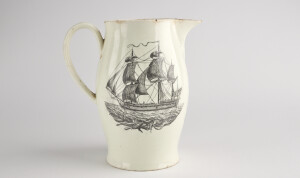 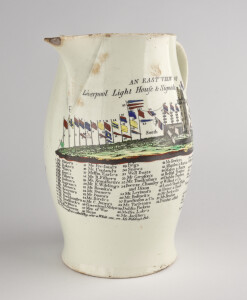 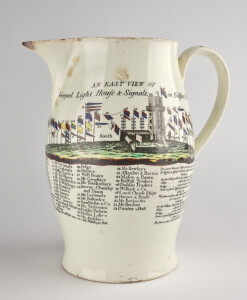 | SHORT DESCRIPTION: Creamware pitcher of baluster form (wide-bellied and tapering to the top rim and foot) with a loop handle. The pitcher is 7-1/16” height and 7” width overall including the spout and handle. The diameter of the rim is 3-⅝” and the diameter of the base, which is slightly splayed, is 3-¾”. The pitcher is approximately 5” width at the center of the bulbous section of the jug. The spout stands about 1-½” from the rim and the loop handle is 2” at its deepest point and 11/16” wide. The pitcher is in fair to good condition with some random staining near the rim. The spout is chipped and darkly stained at the tip. The pitcher is decorated with black transfer-printed images, one of which has been highlighted with colored enamel. On one side is a black transfer-printed image showing a port broadside view of a full-rigged British merchant ship under sail. The sails set include a flying jib and jib on the bowsprit. On the foremast a foresail, fore topsail and fore topgallant sail (which is set but the yard isn’t hoisted) are set. Between the foremast and mainmast a main topmast staysail is set. On the mainmast the mainsail is furled, the main topsail and main topgallant sail are set, but again the yard of the main topgallant sail has not been hoisted leaving the sail billowing. On the mizzenmast the mizzen topsail is set and the mizzen sail is furled. A long pennant with a forked fly end flies from the mainmast. A British flag flies at the stern. Framing the sea at the bottom of the image is a maritime vignette of an anchor, cannon, drum, flag, spears, buoy and other items. On the opposite side is a black transfer-printed view of the signal tower and flagpoles at Bidston Hill (the windmill is not included), including flags numbered from 1 to 52 sitting to the north and south of the lighthouse. The transfer-print is titled “An East View of Liverpool Light House & Signals on Bidston Hill.” The flags are painted in overglaze enamels in red, blue, yellow and white. The lighthouse is painted in shades of gray while the ground underneath is painted in green, yellow and brown/red. At the top of the lighthouse, to the left of flag 31, is the Liver Bird, the symbol of Liverpool. Beneath the image is a numbered list of the shipowners keyed to the flags and a set of instructions for reading the signals. At the base of the spout there is a fragment of a printed compass rose turned on its side to orient north to the right. Half of the rose and the directional arrow were not transferred to the pitcher leaving an odd curved “E”. Reading from left to right, the names, in four columns, are: 1. Mr. Slater's; 2. Mr. Baker's; 3. Mr. Watt's; 4. Mr. Kent's; 5. Mr. Fisher's; 6. Mr. Bolton's; 7. Mr. Ingram's; 8. Mr. Ashton's; 9. Mr. Kenyon's; 10. Mr. Bent's; 11. Mr. Backhouse's; 12. Mr. Bradstock's; 13. Mr. Dickson's; 14. Messrs. Brown's; 15. Mr. Freeland's; 16. Mr. Copland's; 17. Messrs. Earle's; 18. Mr. R. Fisher's; 19. Mr. Staniforth's; 20. Mr. R. Wilding's; 21. Mr. Brooks's; 22. Mr. France's; 23. Mr. Boats's; 24. Mr. Birch's; 25. Mr. C. Jones's; 26. Greenland Ships; 27. Men of War; 28. Ships; 29. Brigs; 30. Snows; 31. Well Boats; 32. Mr. Gregson's; 33. Mr. Tomlinson's; 34. Breeze, Chamley and Dixon; 35. Mr. Leyland's; 36. Mr. Bostock's; 37. Rawlinson & Co.; 38. Mr. Tarleton's; 39. Dublin Packets; 40. Messrs. Lakes's; 41. Mr. Jackson's; 42. Mr. Kewley's; 43. Allanson & Barton; 44. Mason & Bourn; 45. Belfast Traders; 46. Dublin Traders; 47. Willock & Co.; 48. London Cheese Ships; 49. Harper & Brade; 50. Mr. Beckwith's; 51. Mr. Benson's; 52. Dunbar & Hall and one unnumbered name: Mr. Thompson's a Red Flag over a White one, on Mr. Wilding's Pole. To the right of the columns are the instructions for reading the signals. In two sentences in two lines is the text: For more than four vessels of one kind a Flag on the proper staff. For Vessels in Distress or on shore in the Rock Channel or about Hoyle. Followed by the signals for vessels coming in: On the Oblique Pole to the Southward of the Light House; Ship....a Ball with a Flag half Mast.; Brigg.....a cone broad end & Flag half Mast.; Snow or small Vessel dº. small end up & a Flag dº; and the signals for vessels going out: The same as above but a broad Pendant instead of a Flag. The instructions also provide signals for vessels “In Formby Channel”: for vessels coming in: On the Oblique Pole to the Northward of the Light House; Ship.....a Ball with a Flag half Mast; Brigg.....a Cone Broad end up & Flag half Mast; Snow or small Vessel dº. small end up & a Flag dº. Signals for vessels going out: The same as above but a broad Pendant instead of a Flag. The jug is unmarked leaving the manufacturer(s) identified. In Transactions of the Historic Society of Lancashire and Cheshire, session 1880-1881, volume XXXIII, Charles T. Gattey discusses local manufacturers in the article “The Liverpool Potteries.” Gatty indicates the firm of John Sadler and Guy Green on Harrington Street were early producers of printing on pottery. Unfortunately, Sadler retired in 1770 which predates the estimated date of this jug (1790-1792). Gatty does indicate that “much of the ware upon which their [Sadler and Green] prints appear were made by Josiah Wedgwood. According to printedbritishpotteryandporcelain.com, “From about 1761 Wedgwood was sending creamware to Liverpool to be printed at the Sadler workshop. This grew into a large business and continued into the period when [Guy] Green was running the printing business alone.” As there weren’t too many firms actively printing on pottery in Liverpool at the time, it’s possible this jug was one of those printed and decorated by Green (who didn’t retire until 1799) for the Liverpool market. If, as printedbritishpotteryandporcelain.com states, the business between Wedgwood and Green was large, it’s possible that Green bought creamware from Wedgwood for the printing of the Bidston Hill images. Of course, this is merely conjecture at this point. NOTES: According to bidstonhill.org.uk in 1763 a signal station was built on Bidston Hill and functioned as a complicated early warning system using flags and flagpoles. Bidston Hill can be seen for many miles in all directions and the windmill there served as a navigational daymark long before the erection of the signal station. In 1778 there were 14 flagpoles and by 1820 there were 195 poles. Each flagpole was 30 ft (9.14 m) tall and made of Baltic Pine. As merchant ships rounded the Point of Ayr or sailed past Formby Point the ship would be spotted and identified. Flag runners were employed to watch for ships and had 11 minutes to raise the correct company’s flag on the right pole, followed by the correct cargo flag. This enabled supervisors in the docks to ready their workforce to unload the ship (and it meant the workers would be paid only for the time they spent working). The flag signaling station operated until about 1840. A lighthouse was built at the station in 1771 by Liverpool's dockmaster William Hutchinson as a navigational aid. The lighthouse was designed to work in conjunction with the Leasowe Lighthouse to form a pair of leading lights that helped ships avoid sandbanks in the channel to Liverpool. In his 1795 history of Liverpool, James Wallace wrote: “There are at this time fifty-eight [signals], of which forty-nine belong to particular merchants, the remainder are to distinguish and shew if the vessels coming in are Greenlanders, men of war, or if the vessel is ship, brig, or snow; there are also immediate signals to the town of all vessels seen in distress in either of the channels, that thereby speedy assistance may be given.” NOTES: According to printedbritishpotteryandporcelain.com, the earliest version of the Bidston Hill image is dated 1788 and has 43 numbered flags. A second version with 47 numbered flags was also produced in 1789. On the 1789 image, Mr. Galley's name appears but Mr. Orange's does not indicated the image was produced sometime between January (Orange's death) and April 1789 (Galley's death). In 1793 a third version with 56 numbered flags was produced and after France declared war on Britain a fourth version with a new flag indicating “Enemies” was added. Taking this information and other examined jugs into account, this pitcher may date to the 1790-1792 time period. NOTES: The flags in the image represent a mix of Liverpool merchants, many of which are engaged in the slave trade. Research has been unable to provide the exact identities of some of the men/companies. 1) Gill Slater was a Liverpool merchant who made 48 slave trading voyages between 1759 and 1793. Slater was part owner of the ships: Richmond, Hannah, Prince Tom, Betty, York, Lancashire Witch, Ingram, Kitty, Will, Sportsman, President, Defiance, Tartar, Wasp, Edward, Saint Leger, King George, Anna, Chesterfield, Comet, Mary (wholly owned), Seaflower, Commerce, Isabella and Tammerlane. He appears to have conducted other business as he was part owner of a fishing smack named Liver. Slater also conducted privateering voyages during the American Revolution. In 1777 Slater was part of a committee formed to draw up a plan for the better regulation of the slave trade. 2) Peter Baker (1731-1796) was a Liverpool merchant and slave trader in partnership with his son-in-law, John Dawson. According to the Slaving Voyages database, between 1768 and 1789 Baker was part owner of ships on 54 slaving voyages. He and Dawson started slaving voyages together in 1781 (both were active before that point, just not together). According to Stephen Behrendt in “The Captains in the British Slave Trade from 1785 to 1807” between 1783 and 1792 Baker and Dawson was the largest company of slave traders in England and had a contract with the Spanish government to supply enslaved peoples to the Spanish colonies between 1785 and 1788. Behrendt states that even after the Spanish market opened to all merchants in 1788, Baker and Dawson remained the leading British slave trader to the Spanish Caribbean. Captain William Sherwood was given command of Baker & Dawson's Princess Royal (596) from 1786 to 1788, Brothers (325) in 1789, Garland (525) in 1790 and 1791, and Elliot (271) in 1792. Between 1785 and 1795 Joseph Fayrer sailed four voyages for Baker & Dawson, William Forbes and Joseph Withers each sailed five, and Thomas Molyneux commanded six. Ships partially or wholly owned by Baker and Dawson included: Mosley Hill, Princess Royal, Hero, Champion, Telemachus, Prince, Elliott, Garland Sisters, Young Hero, Brothers, Blaydes, Carnatic, and Mentor. According to William Gomer in History of the Liverpool Privateers and Letters of Marque: With an Account of the Liverpool Slave Trade Baker and Dawson had a shipbuilding firm on the Estuary Bank. 3) Richard Watt (1724-1796), a Liverpool merchant. According to History of the Liverpool Privateers and Letters of Marque: Richard Watt came to Liverpool from Standish, near Wigan, around 1740 and was hired by Mr. Geoffry Walley to look after his horse and chaise. Watt was sent to evening school and Walley advanced him to the counting house and employed Watt as a supercargo to Jamaica. Watt settled in Jamaica and made a large fortune. Watt returned to Liverpool in August 1782 as head of the firm Messrs. Watt and Walker. Watt died in 1796 leaving a fortune of around half-a-million pounds to his two nephews, Richard Watt and Richard Walker. 4) Richard Kent, Liverpool merchant. The Voice of Liverpool Business: The first chamber of commerce and the Atlantic economy, 1774-c.1796, by R. J. Bennett, R. J., lists Ken as a timber and general merchant and ship-owner with a salt manufactory at Northwich and a white lead manufactory. His primarily market was America. 5) John Fisher (1740-1791), Liverpool merchant and periodic slave trader. R. J. Bennett describes him as a major ship-owner, ship builder and merchant, conducting some slaving. Fisher owned ships (Betsey, Assistance, Philip Stevens and Robust) that conducted six slaving voyages between 1787 and 1792. 6) John Bolton (1756-1837), major Liverpool merchant, slave trader and slave owner (with Staniforth, Brooks Slater and Ryan). Between 1788 and 1807 Bolton was part owner of ships that conducted 68 slaving voyages (President, Comet, Abigail, Bolton, Gudgeon, Surprise, Maria, Betsey, Cart, King George, John, Christopher, and Elizabeth). 7) Francis Ingram (1793-1815), Liverpool merchant, slave trader and privateer. Merchant in tar and pitch, ship owner (with Earle, Leyland and Staniforth), slaver, and banker. Owner of the privateer Enterprize/Enterprise in 1779/1780. Company Messrs. Francis Ingram & Co. Started slaving in 1761, between 1785 and 1804 partly owners ships conducted 57 slaving voyages (Kitty, Darnall, Hornet, Ingram, Brooks, Mary, Dick, Elliot, Blaydes, Aeolus, Albion, Clemison, Ann, Onslow, George, King George, Liverpool Hero, and Huges). 8) Nicholas Ashton (1742-1833), Liverpool merchant exporting salt and coat to America. Ship owner. Saltworks at St. Helens and Dungeon. Coal mining and salt at St. Helens with George Case. Co-owned the privateer Marchioness of Granby (260 tons, 20 guns) with the Marquis of Granby. Messrs. Ashton & Co owned a small privateer Lady Granby (45 tons, 10 guns) and Jenny (80 tons, 12 guns). 9) James Kenyon, Liverpool merchant and cotton importer. Fourth largest cotton importer in Liverpool. A. Krichtal, in an unpublished masters thesis titled Liverpool and the Raw Cotton Trade: A Study of the Port and its Merchant Community, 1770-1815 identifies James Kenyon as the 4th largest Liverpool cotton importer from the West Indies, 1786-1815, sourcing 5,277,880 lbs in this time period, and cites his main cotton supply area as Barbados. He was particularly active in the 1790s when he was the 3rd highest Liverpool cotton importer from all locations, sourcing 4,403,000 lbs. Krichtal also indicates he was one of several major Liverpool cotton importers who, while not heavily invested in slave trading, did become strongly involved in the shipping of plantation supplies to the Caribbean. 10) Robert Bent (1744/1745-1831/1832) Liverpool merchant and slave trader. MP for Aylesbury. Slave trader with Ellis Bent. He was a major slave-trader with 38 voyages recorded in the 1790s and early 1800s, most from Liverpool but with three from London. Slaving Voyages database lists 37 voyages between 1783 and 1804 (ships: Stanley, Lady Penrhyn, Renown, Ellis, Clemson, Abigail, Susannah, Little Ben, Ariel, Chambres, Ocean, Britannia, William, King William, and Hector). 11) Mr. Backhouse: there were four merchants named Backhouse in Liverpool Registry of Merchant Ships (Daniel, John, Stephen, and Thomas). A likely candidate is Daniel Backhouse (1741-1811) who was a Liverpool merchant and major ship-owner (with Tarleton and others) who also engaged in slaving. He was a Chamber of Commerce member. Daniel was also part owner of the privateer ship named Jenny (140 tons) as well as a privateer brig named Jenny. 12) Garstang Bradstock, Liverpool merchant, ship owner, and periodic slave trader. Bradstock started slaving voyages in 1781 and stopped in 1795. He was part owner of the slave ships Benedict, Juno, Tartar, Tom and Betsey and Brothers. 13) William Dickson Sr. (1740-1802), Liverpool merchant and slave trader. Part or whole owner ships conducting 32 slaving voyages between 1783 and 1800 (ships: Benson, Henrietta, Mary, James, Joshua, Commerce, Tamerland, Sarah, and Vanguard). He was joined by his sons in shipowner/slaving in 1796. 14) Messrs. Brown: There are multiple men named Brown in Liverpool Register of Merchant Ships (George, George, Gwin, Henry and John). There is also a man with the name spelled Browne. The Slave Voyages database lists a number of men named Brown/Browne. On only one voyage are two Brown/Browne's joined (1793) so in most cases it doesn't seem like the men are in business together. Henry Brown and George Browne in LRoMS are owners of four ships together. It’s possible this is the relationship that prompted a flag on Bidston Hill and the distinction between the spellings of the name was just ignored in the production of the pitcher. 15) Peter Freeland (1748-1795?), Liverpool Merchant and one time slave trader (ship named Edward in 1784 ). In 1779 Peter was a 1/16th owner of the privateer Enterprize/Enterprise. He also owned a privateer named Basil. 16) John Copland (born 1727?), Liverpool merchant and slave trader. Copland was the part owner of ships that conducted 41 slaving voyages between 1780 and 1794 (ships Kitty, Oronoko, Perseverance, Preston, Betty, Thomas, John, Peggy, Christopher, and Nancy). 17) Probably Thomas (1754-1822) and William Earle (1759-1839) (firm of T & W Earle & Co.), sons of William Earle (1721-1788), a major Liverpool merchant who operated a packet service to Leghorn (Livorno). He was a major ship owner with Hodgson, Ingram and Leyland. William (Sr.) began making slaving voyages in 1754. A Ralph Earle joined William in partial ownership of some vessels starting in 1763 (brother born 1715). Thomas's first slaving voyage is 1768 and all three men had part ownership of Dispatch, Mentor, and Ann. William Jr.'s first slaving voyage was Preston in 1780 with Thomas Jr. and William. The Earle’s were full or part owners of ships conducting 168 voyages between 1754 and 1805. According to Nichoas Radburn in “William Davenport, the Slave Trade, and Merchant Enterprise in Eighteenth Century Liverpool” William Earle was the sixth most active slave trader in the 1740-1790 period in Liverpool. 18) Ralph Fisher (1746-1803), Liverpool merchant and prolific slave trader. Part owner of ships that conducted 93 slaving voyages between 1782 and 1801. 19) Thomas Staniforth (1735-1803), Liverpool merchant, slave trader and politician. Chamber of Commerce deputy chair in 1777 and 1781, Lord Mayor of Liverpool 1797-1798. Part owner of ships that conducted 79 slaving voyages between 1758 and 1806. See: Chapter 3, Portrait of a Slave-Trading Family: The Staniforths of Liverpool, by Jane Longmore in Britain’s History and Memory of Transatlantic Slavery. 20) Richard Wilding (died 1797), Bidston Hill lighthouse keeper and slave trader. According to Dr. Stephen Pickles, Richard Wilding was the keeper of Bidston lighthouse until his death in 1797. He states: We know that Richard Wilding had one of the flags on Bidston Hill (indeed it is referred to in a Letter of Marque in Gomer William's book "History of the Liverpool Privateers and Letters of Marque with an Account of the Liverpool Slave Trade 1774-1812.") Part owner of ships that conducted 26 slaving voyages between 1777 and 1791. 21) Joseph Brooks Jr. (1746–1823), Liverpool merchant, major shipowner, and slave trader (with Ingram, Stanifordh, Carruthers, Slater and Ryan). May have also been owner of a privateer in 1779. Bailiff of Liverpool in 1784 and 1802. Co-owner of the slave ship Brooks/Brookes which was the subject of a broadside by abolitionist William Elford in 1788. 22) James France (1728-1795), Liverpool merchant. Owner of several privateers (James, Tyger). In partnership with Thomas Hayhurst in France & Co./France & Nephew. The company also owned several privateers (Ellen, Mary Fearon). Imported sugar rum and other commodities from the West Indies. In 1793 James France initiated the construction of a gigantic 14-story warehouse situated in the Goree area of Liverpool (between Water, Brunswick and Drury streets). It became known as one of the Goree Warehouses. This area was later named Back Goree. The warehouse is recognizable in late 18th century images by its immense size and a large weathervane in the shape of a ship that capped the building (burned down in 1802). 23) William Boats (1716-1794) According to “History of the Liverpool Privateers and Letters of Marque: With an Account of the Liverpool Slave Trade” William Boats/Boates (nicknamed “Billy Boats/Boates”) had been found in a boat as a child and was brought up by the person that found him who gave him the surname Boats. He was placed in the Blue Coat School and then served an apprenticeship at sea. He rose to be the commander of a slave ship and eventually became one of the leading merchants and shipowners of Liverpool. In 1779/1780 Messrs. Boats and [John] Gregson owned two privateers (Ellis (340 tons, 24 guns) and Gregson (250 tons, 24 guns). Boats was responsible for 157 slave voyages. 24) Joseph Birch (1755-1833) Liverpool merchant, slave ship owner and politician; MP for Nottingham. Birch was associated with nine voyages from Liverpool and owned stock in the East India Company. Member of the West India Planters and Merchants committee. 25) C. Jones: Might this be the Liverpool merchant and slave trader named John Chambres Jones? 26) Greenland ships are ships involved in whaling. 27) Men of War are the signal for Royal Navy warships. 28) Ships is a generic category for all other ships. 29) Brigs are fast, maneuverable two-masted ships. 30) Snows are similar to brigs, but with the addition of a secondary mast immediately behind the main mast. 31) Well boats are cod smacks or boats with wells to keep fish alive until delivery. 32) William Gregson Sr. (1721-1800), Liverpool merchant and prolific slave trader. Between 1745 and 1801 Gregson and his sons (John and James) conducted 213 slave voyages between 1745 and 1801. Gregson served as Lord Mayor of Liverpool in 1762. In his later career he branched out into banking and insurance. According to Carolyn Dalton in “Memorial to Zong: The Gregson Syndicate” Gregson's vessels carried 58,201 Africans of whom 9,148 died on board. The Gregson’s, along with Edward Wilson and James Aspinall were the owners of the slave ship Zong. On a voyage in 1781 the ship missed its destination in the Caribbean thanks to a navigational error and spent an extra three weeks at sea. Drinking water grew short and some of the enslaved Africans and crew became sick. The crew threw approximately 131 Africans overboard so the merchants could claim insurance money for the “lost cargo.” The case came to symbolize the horrors of the Middle Passage and strengthened the abolition movement. 33) John Tomlinson, Liverpool merchant trading in Lisbon/Oporto. A man named John Tomlinson made 51 slaving voyages between 1759 and 1787. No slaving voyages attributed to John Tomlinson were made after 1787 and only one ship name in the LRoMS appears on a slaving voyage with Tomlinson's name. The following advertisements were found: Leeds Intelligencer for a voyage of the Grape to Lisbon in September 1786; in Gore's Liverpool General Advertiser, May 28, 1795, a voyage for the ship Sisters to Lisbon and ship Brothers to Oporto); the same source dated August 20, 1795 documents a voyage of the ship Rochdale to Lisbon. It seems odd that such a prolific slave trader suddenly stopped and became a merchant to Lisbon/Oporto. I think there might be a mistake here or maybe the business moved from father to son and the son was not a slave trader? Since there were no slaving voyages after 1787 and the first ceramics with Bidston Hill image didn't come out until 1788, I'm limiting John Tomlinson to merchant. 34) Samuel Breeze, Thomas Chamley and Jonathan Dixon, Liverpool merchants and shipowners between 1786 and 1799. Breeze never appears in slaving voyage. Chamley and Dixon names appear together on 3 slave voyages between 1801 and 1803. The company itself does not appear to be conducting slave trading activities. 35) Thomas Leyland (1752–1827), Liverpool merchant, slave trader, and a politician who was Lord Mayor of Liverpool three times (1798, 1814 and 1820). In 1774, he formed the company Dillon and Leyland which traded food produce with Ireland. In 1776, with Dillon he bought a lottery ticket and they won £20,000. Leyland used his half to set up a bank to finance slave trading voyages. According to the Slave Voyages database, between 1783 and 1807 he had an interest in 72 slaving voyages out of Liverpool. He subsequently entered into banking, and set up Leyland & Bullin bank in 1806. When Leyland died on May 29, 1827 he left a fortune of £600,000, making him one of the wealthiest men in Britain. 36) Robert Bostock (1743-1793), Liverpool merchant and slave trader, agent for the Chamber of Commerce of Liverpool in 1782 and MP for Liverpool (1780-1784). Bostock was part owner of ships on 33 slave trading voyages between 1769 and 1793. 37) Rawlinson & Co. There were a number of Rawlinson’s involved in business in Liverpool. Henry Rawlinson (1743-1786), agent for the Chamber of Commerce of Liverpool 1782 and MP for Liverpool (1780-1784), and a merchant who owned property in the West Indies. Henry was a partner in Rawlinsons & Chorley with John Chorley but I found no evidence this company existed after 1776). Henry is documented as holding shares in the slave ship Molly along with Abraham Rawlinson Jr. in 1776. Henry died two years before the first pitcher with the Bidston Hill image was produced so it seems unlikely this is the right man. Abraham Rawlinson (1738-1803) was an English politician and merchant, but he traded out of the port of Lancaster. I also found an A. and J. Rawlinson in business together in 1781, possibly in Liverpool. 38) Mr. Tarleton. There were a number of men named Tarleton active in Liverpool at the time this pitcher was produced. Thomas Tarleton (1753–1820) [Centre for the Study of the Legacies of British Slavery: Liverpool slave-trader and slave-owner on Grenada. Other brothers were: John Tarleton, Banastre Tarleton and Clayton Tarleton. Thomas Tarleton & Co. were also shown as the owners of La Resource in Demerara in 1798. Thomas Tarleton had been paid £68,000 on his withdrawal from the slave-trading and West India mercantile partnership with John Tarleton and Daniel Backhouse [at a date not given].], John Tarleton (1755–1841), Clayton Tarleton, John Tarleton Jr., and Jane Tarleton, slave traders. 39) Dublin packets were cargo ships traveling between Liverpool and Dublin. 40) Messrs. Lake were William Charles Lake (1753-1836), Thomas Lake, Richard Lake (of Jamaica), Liverpool merchant, Irish shipping packet service, and slave traders who were part owners of ships conducting 12 slaving voyages between 1773 and 1788. William Charles Lake was the son-in-law of William Orange. When Orange died in 1789, William Charles Lake & Company took over Orang'es Liverpool to Dublin packet service. 41) John Jackson, Liverpool merchant, part owner of slaving ships between 1770-1775. I’m not entirely sure this is the right gentleman. 42) Patrick, John and Philip Kewley, Liverpool merchants and slave traders. Between 1784 and 1787 John was part owner in ships conducting 13 slaving voyages. Between 1788 and 1800 the John and Patrick were part owners of ships conducting 40 slaving voyages. John was part owner of ships conducting 3 slaving voyages between 1801 and 1803. Philip’s name does not appear as the owner of ships conducting slaving voyages. Philip was probably a member of Liverpool’s Chamber of Commerce. 43) John Allanson, Thomas Barton (1753-1799), William Barton (1755-1826, lives in Barbados), Liverpool merchants and slave traders. Early 1792 Allanson sold all shares to Bartons; 6 slaving voyages between 1779 and 1784 (nearly all Allanson, 1 in 1784 includes Thomas), 1 voyage in 1784 by Thomas; 2 slaving voyages between 1801-1802 by William partnered with John Higginson. The Bartons specialized in the import of sugar, cotton, and spirits from the island of Barbados to Liverpool. Allanson and Barton obtained letters of marque for their ship captains so they could attack and capture French ships after 1793. 44) Edward Mason and Cornelius Bourne, Liverpool merchants and slave traders (before 1785). Mason & Bourne made 10 slaving voyages between 1768 and 1785; It seems they may have stopped being partners in 1791; found advertisement for the men in the Manchester Mercury June 9, 1789 (selling cyder and Perry), but nothing after that. 45) Belfast traders were cargo ships traveling between Liverpool and Belfast. 46) Dublin traders were ships trading with Ireland. 47) Found William Willock & Co in Chester Chronicle (Chester bumps up against Liverpool) October/November 1775; July/August 1776; March/November 1777; August 1778; August 1779; October 1781; August/October 1782; September 1784; January/May/July/October/December 1785; July 1787; January 1801; possibly active through 1810; Based on the advertisements I'm assuming the company represented on the jug is William Willock & Co. who were simply merchants and not slave traders during the 1788 to 1800 time period. 48) London Cheese Ships were ships coming to collect Cheshire cheese which was exported from Liverpool to London. 49) William Harper (1749–1815) and Robert Brade (1747–1815), slave traders. Owners or part owners of ships conducting 53 slaving voyages between 1784 and 1800. Brade's last slaving voyage was in 1799. William continues in the slave trading business without Brade as part owner in ships that conducted 23 slaving voyages between 1801-1807. 50) William Beckwith, Liverpool merchant who seems to specialize in timber and wood products and goods from and for the West Indies. -Gore’s Liverpool General Advertiser of July 30, 1795 has an advertisement for the rental of a warehouse. Apply to White and Beckwith’s who also have red and white herrings for sale “properly cured for the West India market. -Gore’s Liverpool General Advertiser of October 1, 1795, indicates that the Olive had arrived from Petersburg with materials that included 3 tons of oakum for W. Beckwith. -Gore’s Liverpool General Advertiser of October 2, 1795, carries an advertisement for the sale or charter or the brigantine Alert and ship Olive. Applications should be made to William Beckwith and Co. who also have white herrings on sale, properly packed for exportation. -Gore’s Liverpool General Advertiser of October 15, 1795, the Alert had arrived from Barbadoes with goods that included 5 hogsheads of sugar, 15 bales cotton and 51 goads aloes for W. Beckwith and Co. -Gore’s Liverpool General Advertiser of March 27, 1800, advertisement for elm timber fit for keels, planks, blocks and pumps. Apply to Wm. Beckwith and Co. who has a constant supply of wood hoops suitable for the West Indies. 51) Moses Benson (1738-1806), Liverpool merchant and slave trader. In the 1760s, Benson became a captain in the West India trade for Abraham Rawlinson, a Lancaster merchant, and acted as Rawlinson's agent in Jamaica, before commencing trade in the West Indies on his own account. Having acquired a significant fortune, Benson returned to Liverpool, where in 1775 he entered the slave trade.Between 1776 and 1807 Benson owned shares in ships that carried out 84 slaving voyages. 52) George Dunbar (ca 1749-1811) & George Hall: Liverpool merchants and shippers specializing in timber, fabric goods and tallow. Found Dunbar and Hall in Manchester Mercury, December 1788 (tallow and linen), September 1789 (tallow and hemp), November 1790 (logs, lathwood and hemp), June/August/September/October 1791 (iron, rum, flax, linen and sailcloth). See Aris's Birmingham Gazette, May 16, 1791, page 3 for letter discussing business. No ads after 1791. Found George Dunbar serving as a broker in 1795. The book “Liverpool as it was during the last quarter of the 18th century” states: Mr. George Dunbar, afterwards Sir George Dunbar, Bart.; he subsequently lived in Dale-street, near the Exchange, and afterwards in Mount-pleasant, where he resided when he was mayor, in 1796. 53) There are several merchants with the surname Thompson: The LRoMS lists John Thompson. The Slaving Voyages database has the names John Thompson and William Thompson. John owned shares in ships that conducted three slave trading voyages between 1785 and 1793. William owned shares in ships that conducted 22 slaving voyages between 1792 and 1800. As the surname Thompson is fairly common it unclear which Thompson this jug represents. NOTES: Notes made in the China File by Nola Hill - work done in the '40's or early 50's per Harold Sniffen, 12/7/81... East View of Liverpool Light House and Signals on Bidston Hill, with 52 listings of signals Reverse Full rigged British Ship c. 1800 Liverpool ware transfers in colors 7-1/8 x 4-3/4 inches (See also FN 225 (broken) | CL5680 | |||||||
| 25 | 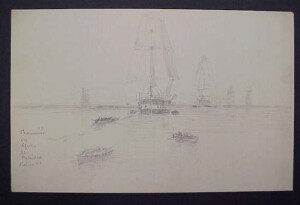 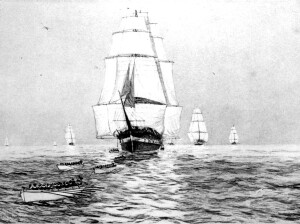 | SHORT DESCRIPTION: Pencil sketch made as preliminary drawing of illustration titled "Constitution Towing and Kedging" for Naval Actions of the War of 1812 by James Barnes. NOTES: [From: Naval Actions of the War of 1812, Author: James Barnes, Illustrator: Carlton T. Chapman] If during the naval war of 1812 any one man won laurels because he understood his ship, and thus triumphed over odds, that man was Captain Hull, and the ship was the old Constitution. Returning from a mission to Europe during the uncertain, feverish days that preceded the declaration of war between England and America, Hull had drawn into the Chesapeake to outfit for a cruise. He had experienced a number of exciting moments in European waters, for everything was in a turmoil and every sail suspicious—armed vessels approached one another like dogs who show their fangs. Although we were at peace, on more than one occasion Hull had called his men to quarters, fearing mischief. Once he did so in an English port, for he well remembered the affair of the Leopard and the Chesapeake. At Annapolis he shipped a new crew, and on July 12th he sailed around the capes and made out to sea. Five days later, when out of sight of land, sailing with a light breeze from the northeast, four sail were discovered to the north, heading to the westward. An hour later a fifth sail was seen to the northward and eastward. Before sunset it could be declared positively that the strangers were vessels of war, and without doubt English. The wind was fair for the nearest one to close, but before she came within three miles the breeze that had brought her up died out, and after a calm that lasted but a few minutes the light wind came from the southward, giving the Constitution the weather-gage. And now began a test of seamanship and sailing powers, the like of which has no equal in history for prolonged excitement. Captain Hull was almost alone in his opinion that the Constitution was a fast sailer. But it must be remembered, however, that a vessel’s speed depends upon her handling, and with Isaac Hull on deck she had the best of it. All through the night, which was not dark, signals and lights flashed from the vessels to leeward. The Constitution, it is claimed by the English, was taken for one of their own ships. She herself had shown the private signal of the day, thinking perhaps that the vessel near to hand might be an American. Before daybreak three rockets arose from the ship astern of the Constitution, and at the same time she fired two guns. She was H. M. S. Guerrière, and, odd to relate, before long she was to strike her flag to the very frigate that was now so anxious to escape from her. Now, to the consternation of all, as daylight broadened, three sail were discovered on the starboard quarter and three more astern. Soon another one was spied to the westward. By nine o’clock, when the mists had lifted, the Constitution had to leeward and astern of her seven sail in sight—two frigates, a ship of the line, two smaller frigates, a brig, and a schooner. There was no doubt as to who they were, for in the light breeze the British colors tossed at their peaks. It was a squadron of Captain Sir Philip Vere Broke, and he would have given his right hand to have been able to lessen the distance between him and the chase. But, luckily for “Old Ironsides,” all of the Englishmen were beyond gunshot. Hull hoisted out his boats ahead, and they began the weary work of towing; at the same time, stern-chasers were run out over the after-bulwarks and through the cabin windows. It fell dead calm, and before long all of the English vessels had begun to tow also. But the Constitution had the best position for this kind of work, as she could have smashed the boats of an approaching vessel, while her own were protected by her hull. One of the nearest frigates, the Shannon, soon opened fire, but her shot fell short, and she gave it up as useless. At this moment a brilliant idea occurred to Lieutenant Morris of the Constitution. It had often been the custom in our service to warp ships to their anchorage by means of kedge-anchors when in a narrow channel; by skillful handling they had sometimes maintained a speed of three knots an hour. Hull himself gives the credit for this idea to Lieutenant Charles Morris. All the spare hawsers and rope that would stand the strain were spliced together, and a line almost a mile in length was towed ahead of the ship and a kedge-anchor dropped. At once the Constitution began to walk away from her pursuers—as she tripped one kedge she commenced to haul upon another. Now for the first time Hull displayed his colors and fired a gun; but it was not long before the British discovered the Yankee trick and were trying it themselves. A slight breeze happily sprang up, which the Constitution caught first and forged ahead of the leading vessel, that had fifteen or sixteen boats towing away at her. Soon it fell calm again, and the towing and kedging were resumed. But the Belvidera, headed by a flotilla of rowboats, gained once more, and Hull sent overboard some twenty-four hundred gallons of water to lighten his vessel. A few shots were exchanged without result. But without ceasing the wearisome work went on, and never a grumble was heard, although the men had been on duty and hard at work twelve hours and more. This was to be only the beginning of it. Now and then breezes would spring from the southward, and the tired sailors would seize the occasion to throw themselves on the deck and rest, often falling asleep leaning across the guns—the crews had never left their quarters. From eleven o’clock in the evening until past midnight the breeze held strong enough to keep the Constitution in advance. Then it fell dead calm once more. Captain Hull decided to give his men the much-needed respite; and, except for those aloft and the man at the wheel, they slept at their posts; but at 2 A.M. the boats were out again. During this respite the Guerrière had gained, and was off the lee beam. It seemed as if it were impossible to avoid an action, and Hull had found that two of his heavy stern-chasers were almost worse than useless, as the blast of their discharge threatened to blow out the stern-quarters, owing to the overhanging of the wood-work and the shortness of the guns. The soundings had run from twenty-six to twenty-four fathoms, and now Hull was afraid of getting into deeper water, where kedging would be of no use. At daybreak three of the enemy’s frigates had crept up to within long gunshot on the lee quarter, and the Guerrière maintained her position on the beam. The Africa, the ship of the line, and the two smaller vessels had fallen far behind. Slowly but surely the Belvidera drew ahead of the Guerrière, and at last she was almost off the Constitution’s bow when she tacked. Hull, to preserve his position and the advantage of being to windward, was obliged to follow suit. It must have been a wondrous sight at this moment to the unskilled eye; escape would have seemed impossible, for the American was apparently in the midst of the foe. Rapidly approaching her on another tack was the frigate Æolus within long range, but she and the Constitution passed one another without firing. The breeze freshening, Hull hoisted in his boats, and the weary rowers rested their strained arms. All the English vessels rounded upon the same tack as the Constitution, and now the five frigates had out all their kites, and were masses of shining canvas from their trucks to the water’s edge. Counting the Constitution, eleven sail were in sight, and soon a twelfth appeared to the windward. It was evident that she was an American merchantman, as she threw out her colors upon sighting the squadron. The Englishmen did not despatch a vessel to pursue her, but to encourage her to come down to them they all flew the stars and stripes. Hull straightway, as a warning, drew down his own flag and set the English ensign. This had the desired effect, and the merchantman hauled on the wind and made his best efforts to escape. Hull had kept his sails wet with hose and bucket, in order to hold the wind, and by ten o’clock his crew had started cheering and laughing, for they were slowly drawing ahead; the Belvidera was directly in their wake, distant almost three miles. The other vessels were scattered to leeward, two frigates were on the lee quarter five miles away, and the Africa, holding the opposite tack, was hull down on the horizon. The latitude was made out at midday to be 38° 47´ north, and the longitude, by dead reckoning, 73° 57´ west. The wind freshened in the early afternoon, and, the sails being trimmed and watched closely, Hull’s claim that his old ship was a stepper, if put to it, was verified, for she gained two miles and more upon the pursuers. And now strategy was to come into play. Dark, angry-looking clouds and deeper shadows on the water to windward showed that a sudden squall was approaching. It was plain that rain was falling and would reach the American frigate first. The topmen were hurried aloft, the sheets and tacks and clew-lines manned, and the Constitution held on with all sails set, but with everything ready at the command to be let go. As the rush of wind and rain approached all the light canvas was furled, a reef taken in the mizzen-topsail, and the ship was brought under short sail, as if she expected to be laid on her beam ends. The English vessels astern observed this, and probably expected that a hard blow was going to follow, for they let go and hauled down as they were, without waiting for the wind to reach them. Some of them hove to and began to reef, and they scattered in different directions, as if for safety. But no sooner had the rain shrouded the Constitution than Hull sheeted home, hoisted his fore and main topgallant-sails, and, with the wind boiling the water all about him, he roared away over the sea at a gait of eleven knots. For an hour the breeze held strong—blowing almost half a gale, in fact—and then it disappeared to leeward. A Yankee cheer broke out in which the officers joined, for the English fleet was far down the wind, and the Africa was barely visible. A few minutes’ more sailing, and the leading frigates were hull below the horizon. Still they held in chase throughout all the night, signalling each other now and then. At daybreak all fear was over; but the Constitution kept all sail, even after Broke’s squadron gave up and hauled to the northward and eastward. The small brig that had been counted in the fleet of the pursuers was the Nautilus, which had been captured by the English three or four days previously. She was the first vessel lost on either side during the war. She was renowned as having been the vessel commanded by the gallant Somers, who lost his life in the harbor of Tripoli. Lieutenant Crane, who had command of her when taken by the English, and who saw the whole chase, speaks of the wonder and astonishment of the British officers at the handling of the Constitution. They expected to see Hull throw overboard his guns and anchors and stave his boats. This they did themselves in a measure, as they cut adrift many of their cutters—and spent some time afterwards in picking them up—by the same token. Nothing had been done to lighten the Constitution but to start the water-casks, as before mentioned. So sure were the English of making a capture that Captain Broke had appointed a prize crew from his vessel, the Shannon, and had claimed the honor of sailing the Constitution into Halifax; but, as a contemporary states, “The gallant gentleman counted his chickens before they were hatched”—a saying trite but true. To quote from the Shannon’s log, under the entry of July 18th, will be of interest: “At dawn” (so it runs) “an American frigate within four miles of the squadron. Had a most fatiguing and anxious chase; both towing and kedging, as opportunity offered. American exchanged a few shots with Belvidera—carried near enemy by partial breeze. Cut our boats adrift, but all in vain; the Constitution sailed well and escaped.” It is recorded in English annals that there were some very sharp recriminations and explanations held in the Shannon’s cabin. Perhaps Captain Hull would have enjoyed being present; but by this time he was headed northward. He ran into Boston harbor for water on the following Sunday. Broke’s squadron separated, hoping to find the Constitution on some future day and force her to action. In this desire Captain Dacres of the Guerrière was successful—so far as the finding was concerned; but the well-known result started American hearts to beating high and cast a gloom over the Parliament of England. The ovations and praises bestowed upon the American commander upon his arrival at Boston induced him to insert the following card on the books of the Exchange Coffee-House: “Captain Hull, finding that his friends in Boston are correctly informed of his situation when chased by the British squadron off New York, and that they are good enough to give him more credit for having escaped it than he ought to claim, takes this opportunity of requesting them to transfer their good wishes to Lieutenant Morris and the other brave officers, and the crew under his command, for their very great exertions and prompt attention to his orders while the enemy were in chase. Captain Hull has great pleasure in saying that, notwithstanding the length of the chase, and the officers and crew being deprived of sleep, and allowed but little refreshment during the time, not a murmur was heard to escape them.” It is rather a remarkable circumstance that the Belvidera, which was one of the vessels that in this long chase did her best to come up with the Constitution, had some months before declined the honor of engaging the President. For, on the 24th of June, Captain Rodgers had fired with his own hand one of the President’s bow-chasers at the Belvidera, and thus opened the war. After exchanging some shots, Captain Byron, of the Belvidera, decided that discretion was the better part, and, lightening his ship, managed to escape. NOTES: Carlton T. Chapman was born September 18, 1860 to Henry and Margaret Chapman. They lived in Ohio, but Chapman spent summers at his uncle’s shipyard in Maine, where his father was born. During his teenage years Chapman worked as a cabinet maker with his father, according to the 1880 census. Chapman’s artwork focused on the maritime world, and after art school the U.S. Naval Academy commissioned him to paint images of the War of 1812, which appear in James Barnes’ “Naval Actions of the War of 1812.” During the Spanish-American War, Harper’s Magazine Weekly sent him as a kind of war correspondent with Admiral Sampson’s fleet to draw the war. His art shows that he was present for many of the significant battles. He married Aurelie Reynaud on November 6, 1911 and won numerous awards throughout his life. Chapman passed away February 12, 1925. | CL25857 |
Created 2026 by Don Barker, CBMM volunteer, for the Chesapeake Shipbuilding Project. shipbuilding@sailingworkboats.es